There is a moment, just after a truly elevated smile makeover, when everything goes quiet. The teeth are not merely whiter; the entire face appears more composed, more rested, more assured. This is the realm where dentistry steps beyond routine care and becomes a finely calibrated craft. For those considering a dental transformation, understanding what actually happens behind the scenes—clinically, aesthetically, and strategically—can be the difference between a standard result and a signature one.
Below, we explore the core procedures that anchor modern smile makeovers, along with five exclusive insights that discerning patients consistently appreciate but rarely hear explained in depth.
The Modern Smile Makeover: A Suite, Not a Single Procedure
A sophisticated smile transformation is rarely just “veneers” or “whitening.” Instead, it is more akin to a curated treatment suite, where each procedure is selected for its specific contribution to the final composition.
Contemporary makeovers often blend porcelain veneers, ceramic crowns, orthodontic refinement (including clear aligners), selective bonding, professional whitening, and carefully planned gum contouring. In more advanced cases, dental implants and full-arch restorations may form the structural foundation for an entirely new dental architecture.
What sets premium treatment apart is the sequencing and integration: your dentist doesn’t simply add procedures; they choreograph them. Orthodontic alignment may precede veneers to allow for minimally invasive preparations. Gum reshaping may occur before final ceramics are fabricated to ensure that the tooth-to-gum frame is impeccably proportioned. Even whitening is timed with strategic precision, both to serve as a color reference for veneers and to avoid unnecessary sensitivity as other treatments progress.
This orchestration is what elevates a series of procedures into a coherent, natural-looking result that feels as if it could never have been any other way.
Veneers, Crowns, and the Architecture of Porcelain
Porcelain veneers and crowns are often perceived simply as “new teeth,” but in refined dentistry, they are architectural elements. A veneer is a thin, custom-made porcelain layer bonded to the front of the tooth, while a crown covers the entire visible portion, offering both structural reinforcement and cosmetic enhancement.
In a premium setting, the choice between veneer and crown is never purely cosmetic—it is biomechanical. Teeth that are heavily restored, cracked, or root canal–treated may be better served by crowns that protect weakened tooth structure. Intact but aesthetically compromised teeth (with discoloration, minor misalignment, or shape irregularities) are ideal candidates for minimally invasive veneers.
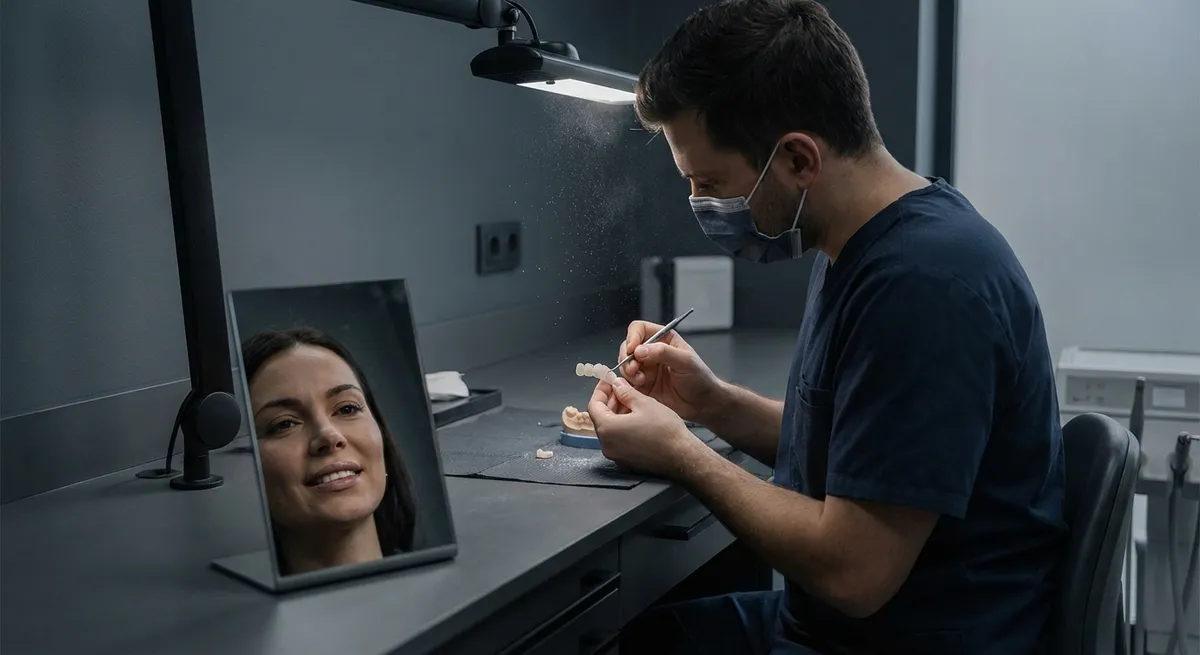
The porcelain itself is also a key design decision. High-end restorations frequently employ advanced ceramics such as lithium disilicate or layered feldspathic porcelain, chosen for their translucency, strength, and ability to mimic the natural interplay of light within enamel and dentin. Instead of a flat “white,” your dentist and ceramist work with micro-gradations of value, chroma, and translucency to achieve a lifelike result that withstands scrutiny in bright daylight, not just studio lighting.
The most refined outcomes come when veneers and crowns are treated less as coverings and more as micro-sculptures—subtle adjustments in length, contour, and surface texture that influence everything from lip support to the way light moves across your smile.
Orthodontic Refinement: The Invisible Stage Before the Reveal
In elevated cosmetic dentistry, orthodontic treatment is not exclusively for teenagers and not only about straightening. It is about creating the ideal spatial canvas upon which the final restorative work can be delicately layered.
Clear aligners and discreet braces can correct crowding, rotations, and bite discrepancies that would otherwise force aggressive tooth reduction or compromise the longevity of veneers and crowns. By aligning the teeth first, your dentist can conserve enamel, place thinner restorations, and distribute bite forces more harmoniously across your smile.
This “invisible stage” is one of the most undervalued steps in a makeover journey. Patients often wish to move directly to veneers for immediate gratification. Yet, those who accept a phase of orthodontic refinement frequently enjoy more natural-looking results with fewer long-term complications, such as chipping, fractures, or excessive wear.
Think of orthodontics as the quiet infrastructure: not the most visible part of the transformation, but essential to ensuring that the visible elements have the best possible foundation.
Gum Contouring and Soft-Tissue Harmonization
An exquisite smile is as much about the frame as it is about the artwork. The gingival (gum) architecture subtly determines whether teeth appear stubby, overlong, or perfectly balanced.
Gum contouring procedures range from conservative laser recontouring to more advanced crown lengthening surgery, where bone and soft tissue are reshaped to establish an ideal tooth-to-gum ratio. The goal is not “less gum” but harmonious gingival symmetry—matching heights between corresponding teeth and ensuring that the gingival line follows a graceful, natural arc.
Premium practices will evaluate the smile both statically and dynamically: how much gum shows during spontaneous laughter versus a gentle smile; whether the upper lip lifts symmetrically; and how the gumline interacts with any planned porcelain. Even a fraction of a millimeter in gum positioning can transform how refined the finished smile appears.
This is the point at which dentistry intersects with facial aesthetics. What might look like a simple “gummy smile” is, in reality, an interplay of tooth length, gum presence, lip mobility, and skeletal position. Addressing the gums with the same level of precision as the teeth is what elevates good results to truly elegant ones.
Five Exclusive Insights for the Discerning Smile Makeover Client
Beyond the standard explanations of “veneers,” “whitening,” and “implants,” there are subtler, insider considerations that shaped the most refined transformations. These five insights are often discussed quietly in high-end treatment rooms—but rarely appear in mainstream discussions.
1. Your Natural Tooth Texture Is a Luxury Reference Point
The very fine vertical ridges, microscopic pits, and gentle undulations on your natural teeth—especially the front incisors—are an invaluable reference for your ceramist. They influence how enamel reflects and diffuses light and are one of the key reasons why some veneers look convincingly natural while others appear unnervingly flat.
In a sophisticated makeover, your dentist will study these patterns under magnification, photograph them at multiple angles, and relay them to a master ceramist. Together, they decide which aspects to replicate and which to refine. Patients who understand this often request “not too polished” surfaces—subtle texture that reads as youthful and authentic rather than overly glazed or artificial.
2. The Way You Speak Quietly Informs the Design
Phonetics—how you form sounds—is an underappreciated design parameter. The length and position of your front teeth gently shape air flow and tongue placement during speech, influencing certain sounds such as “F,” “V,” “S,” and “Th.”
Before final ceramics are crafted, many premium dentists will use provisional (temporary) restorations to test speech in real life. You may be asked to read specific phrases aloud or simply talk as you normally do while the dentist listens and observes. If your “S” begins to whistle slightly or your “F” sounds feel unfamiliar, adjustments to the length or contour of the teeth can be made at the provisional stage.
This quiet phonetic calibration is what prevents a beautiful new smile from coming with an unintended change in how you sound.
3. Trial Smiles Are Not Just for Approval—They Are Data
The temporary phase—often called a “trial smile”—is not merely a preview for your approval; it is a clinical testing ground. During this phase, your dentist observes how the proposed shape, length, and proportion of your new teeth function under real-world conditions.
How do your lips rest at the end of a long day? Do your front teeth lightly contact when you swallow or speak? Does your jaw feel more relaxed or slightly strained? Do you unconsciously “test” the edges of your new teeth with your tongue?
Every one of these details feeds back into the final ceramic design. Patients who treat this as a collaborative refinement phase rather than a passive waiting period often achieve exceptionally tailored, comfortable results.
4. Bite Design Is an Invisible Safeguard for Longevity
While aesthetics may be your initial motivation, the true test of a premium makeover is how it performs under the constant pressures of chewing, clenching, and grinding. Occlusal design—the precise way your upper and lower teeth meet and glide—is an invisible safeguard against chipping, cracking, and chronic jaw tension.
Advanced cosmetic dentists often incorporate digital bite analysis, articulators (devices that simulate jaw movement), and sometimes even night-time bite guards to protect delicate ceramics. A well-designed bite redirects forces away from vulnerable edges, allowing your veneers, crowns, and implants to age gracefully.
The refinement here is subtle: micromillimeter adjustments in contact points that you barely perceive, yet that dramatically influence how quietly and smoothly your teeth function over years.
5. Shade Selection Is Less About “White” and More About Context
In elevated cosmetic dentistry, “shade” is a narrative, not a number. The ideal color for your teeth depends on skin tone, lip color, sclera (the whites of your eyes), age, and even your sartorial style.
Very bright “Hollywood white” shades can look exquisite under studio lighting but may read as harsh under natural daylight, especially against warmer or deeper skin tones. Conversely, slightly warmer, softer shades with subtle gradation from neck to edge often look more luxurious and believable in everyday settings.
Sophisticated practices may use digital smile design systems and shade-matching technology, but they also rely heavily on visual judgment—viewing shade samples under different lighting conditions and sometimes stepping outside with you to see how the proposed color behaves in natural light. Patients who engage in this process, rather than simply asking for “the whitest,” typically end up with a more refined, timeless result.
Integrating Function, Aesthetics, and Personal Identity
The most compelling smile makeovers are those that do not announce themselves. They belong to you so completely that even close friends may comment that you look “rested” or “refreshed,” without immediately pinpointing the source.
Reaching that level of subtlety requires more than a menu of procedures. It demands that your dentist consider your face at rest and in motion, your speaking patterns, your professional presence, and the way you wish to be perceived. Porcelain, orthodontics, gum contouring, and bite design become instruments in a larger composition—your own distinct visual and functional identity.
For those seeking a result that feels both elevated and enduring, the most powerful step is not asking, “What procedures do I need?” but instead, “What story should my smile quietly tell—and how can each procedure contribute to that narrative?”
Conclusion
A sophisticated dental makeover is not defined by a single dramatic procedure, but by a series of precisely orchestrated decisions. From conserving enamel with orthodontic staging to texturing porcelain for lifelike light play, every detail influences whether your new smile looks merely “done” or effortlessly, convincingly yours.
When you understand the deeper layers—architecture, phonetics, bite design, and shade in context—you become an active collaborator in the process. This collaboration is where dentistry transcends standard cosmetic enhancement and enters the realm of truly bespoke transformation: a signature smile that supports your health, complements your features, and quietly elevates every room you enter.
Sources
- American Academy of Cosmetic Dentistry (AACD) – Procedures Overview - Outlines common cosmetic procedures, including veneers, crowns, bonding, and whitening, with patient-focused explanations.
- Mayo Clinic – Dental Veneers - Provides an evidence-based overview of veneer indications, risks, and what to expect during treatment.
- Cleveland Clinic – Dental Crowns - Details when crowns are recommended, how they are placed, and long-term care considerations.
- National Institutes of Health (NIH) – Clear Aligner Therapy Review - Peer-reviewed article exploring effectiveness, indications, and limitations of clear aligner orthodontic treatment.
- American Academy of Periodontology – Crown Lengthening & Esthetic Procedures - Explains cosmetic periodontal treatments such as gum contouring and their role in smile aesthetics.
Key Takeaway
The most important thing to remember from this article is that this information can change how you think about Dental Procedures.