A refined smile is no longer a single procedure; it is a composition. In elite cosmetic practices, smile design has evolved into a discipline that sits somewhere between facial aesthetics, biomimetic dentistry, and couture design. The most beautiful results are not the brightest or the straightest; they are the ones that feel inevitable on your face—as if they always belonged there. This is where true smile design lives: at the intersection of proportion, personality, and quiet precision.
Smile Design as a Portrait of Your Face, Not Just Your Teeth
Conventional dentistry often treats teeth in isolation—straighten, whiten, restore. Contemporary smile design starts from a different vantage point: the face as a whole. Your dentist is not just measuring enamel; they are reading your facial architecture.
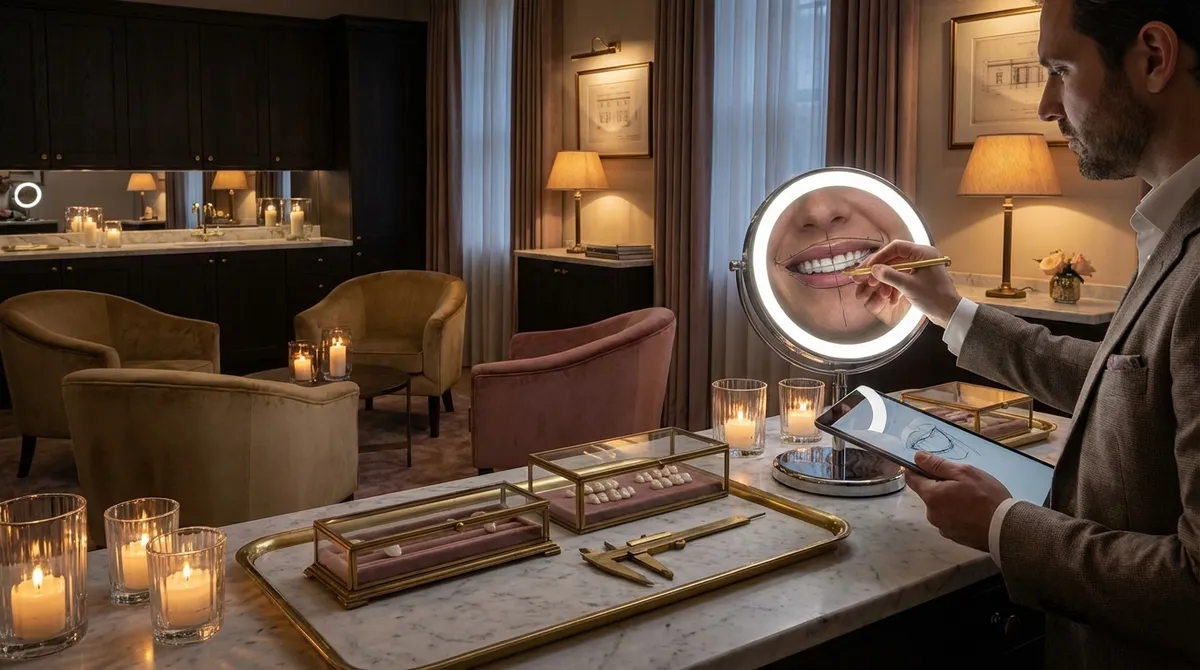
A sophisticated smile design consultation typically begins with facial mapping: analyzing midlines, interpupillary distance, lip mobility, facial thirds, and even habitual expressions. The question is not, “What can we do to your teeth?” but “What smile line, tooth display, and incisal edge position harmonize with your features at rest and in motion?”
Your upper lip length, how much gum you show when you laugh, and how your cheeks lift when you smile all shape the design. Subtle changes—shortening or lengthening the front teeth by fractions of a millimeter, gently altering the incisal angles—can visually balance facial asymmetry, soften a strong jaw, or create a more lifted appearance without touching a single muscle. The result feels less like “new teeth” and more like an edited, refined version of you.
Texture, Translucency, and the Invisible Language of Luxury
To the untrained eye, a veneer is a veneer. To a discerning patient and a top ceramist, the real luxury lies in the surface story of each tooth. Natural enamel is not a flat, uniform white—it has depth, micro-texture, and a subtle play of light that shifts from cervical (near the gumline) to incisal (toward the edge).
High-end smile design leans into this complexity. Your dentist and ceramist will consider:
- Micro-texture: Gentle perikymata (fine vertical ridges) and surface character that prevent teeth from looking flat or artificial under bright light or photography.
- Translucency gradients: Slight translucency at the edges and more opacity toward the center to mimic youthful, healthy enamel.
- Internal effects: Soft halo edges, delicate “mamelons” on incisal tips, or faint opalescent fields that create a living, layered appearance.
Personalization might also include nuanced shade blending rather than a single, uniform bright shade. For many sophisticated patients, the goal is not “Hollywood white” but a curated, believable brightness that aligns with age, skin tone, and lifestyle. This is the difference between a smile that looks expensive and one that looks simply “done.”
Designing for Movement: How Your Smile Performs in Real Life
The most elegant smiles are designed not for a single photograph, but for movement—conversation, laughter, subtle expression. This is where high-level smile design becomes almost cinematic.
Advanced practices often use digital smile design tools, high-definition video, and dynamic photography to observe how your teeth and lips interact in real time. They examine:
- Phonetics: How certain sounds (“F,” “V,” “S”) influence tooth length and position for natural speech.
- Smile arc: The curvature of your upper teeth in relation to your lower lip when you smile broadly.
- Lip dynamics: How far your upper lip rises when you laugh, and whether your lower teeth show at rest or during speech.
Subtle refinements—slightly altering the inclination of the upper incisors, reshaping canine tips, or refining the buccal corridor (the “dark space” at the corners of the mouth)—can make your smile feel more fluid and less static. When done well, the smile never appears to “freeze” or look out of place in candid moments. Instead, it performs beautifully under every expression, lighting condition, and angle.
The Art of Restraint: Elegance in What You Choose Not to Change
One of the most exclusive aspects of modern smile design is the embrace of restraint. In high-end aesthetic dentistry, the most powerful decision is often not what to add, but what to preserve.
An experienced smile designer will identify elements that make your smile uniquely yours—slight asymmetry, a characteristic canine prominence, a gentle midline shift that suits your face—and choose to refine rather than erase them. This considered approach creates:
- Authenticity: A smile that feels like an elevated version of you, not a generic template.
- Longevity: A design that ages gracefully because it respects natural structure and functional balance.
- Subtlety: Results that are noticeable only in how “right” they look, not in how altered they appear.
Restraint also extends to tissue and structure. Minimal-preparation veneers, additive bonding, and conservative contouring respect your enamel and periodontal health. In the most sophisticated cases, the dentist’s touch is nearly invisible—but its impact is profound.
The Private Blueprint: Five Exclusive Insights Before You Commit
Before embarking on a smile transformation, discerning patients benefit from a deeper look behind the scenes. These five insights often remain unspoken, yet they shape the success of your result:
- Your ceramist is as important as your dentist.
For veneer or crown-based makeovers, the ceramist is the artisan translating your dentist’s vision into porcelain. Elite practices collaborate with master ceramists who specialize in ultra-thin restorations, nuanced layering, and hand-finished texture. Always ask who is fabricating your restorations, where they are based, and whether you can see portfolio examples of their work.
- Trial smiles are your dress rehearsal—do not skip them.
A high-level smile design often includes a “prototype” or mock-up phase, where temporary restorations or digital overlays simulate the final outcome. This is when you live with the new shape, test speech, evaluate comfort, and review how your smile photographs in different lighting. Any discomfort, aesthetic hesitation, or functional concern should be resolved at this stage—not after final porcelain is placed.
- Gums frame the entire story.
Even the most exquisite veneers will look compromised if the gumline is uneven, inflamed, or poorly contoured. Soft-tissue refinement—lasers, micro-surgical recontouring, or orthodontic adjustment—can quietly transform the harmony of the smile. For patients seeking a truly elevated result, periodontal health and gum architecture are treated as seriously as the teeth themselves.
- Occlusion is your unseen insurance policy.
Bite dynamics determine whether your new smile remains flawless or slowly chips, fractures, or migrates. A sophisticated clinician will evaluate how your teeth meet and glide, consider any history of grinding or jaw discomfort, and may recommend protective nightguards or micro-adjustments. This is not a technical afterthought; it is what preserves your investment over the next decade and beyond.
- Photography is part of the design, not just the documentation.
In leading cosmetic studios, photography is a design tool. High-quality, protocol-based images reveal details invisible in a mirror: lip symmetry, tooth inclination, midline discrepancies, and surface reflections. These images guide both the dentist and ceramist, and they allow you to participate in the design with a clearer, more objective view of your own smile.
Conclusion
Smile design at its highest level is not a procedure; it is a curated experience that blends science, artistry, and a deep respect for your individuality. The goal is not to announce itself, but to integrate so seamlessly with your face, personality, and movement that it feels undeniably “you”—just more composed, more luminous, more considered.
For those seeking an elevated transformation, the true luxury lies in the details: how enamel catches the light, how your gums frame each tooth, how your smile moves when you laugh without thinking. When these elements are orchestrated with intention and restraint, your smile becomes more than an aesthetic upgrade. It becomes a quiet, enduring expression of your personal standard.
Sources
- American Academy of Cosmetic Dentistry – Smile Design Principles – Overview of how facial and dental proportions guide modern cosmetic smile design.
- Harvard School of Dental Medicine – Esthetic Dentistry Concepts – Educational resource on contemporary aesthetic and restorative approaches in dentistry.
- Journal of the American Dental Association – Esthetic Smile Design00037-1/fulltext) – Clinical discussion of aesthetic parameters used in smile design and treatment planning.
- National Institutes of Health (NIH) – Digital Smile Design and Facial Analysis – Research article exploring digital smile design, facial harmony, and treatment outcomes.
- Mayo Clinic – Dental Health and Cosmetic Dentistry Overview – General guidance on dental health, restorative options, and considerations for cosmetic dental procedures.
Key Takeaway
The most important thing to remember from this article is that this information can change how you think about Smile Design.