A modern smile makeover is no longer a simple sequence of whitening, veneers, and orthodontics. In the hands of a discerning practitioner, dental procedures become an exercise in precision facial refinement—quietly calibrating proportion, symmetry, and light to elevate the entire face. For patients who expect more than a generic “Hollywood smile,” understanding what truly differentiates a refined result from a routine makeover is essential.
This is where exclusive insight matters: the subtle considerations, often unspoken, that separate technically competent dentistry from elevated aesthetic care.
The Shift from “Pretty Teeth” to Full-Face Harmony
High-level cosmetic dentistry has moved decisively beyond isolated teeth. The most sophisticated clinicians begin not with shade tabs or veneer catalogs, but with your resting expression, your dynamic smile, and the architecture of your face.
Aesthetic planning now integrates facial midlines, lip curvature, and even the way your cheeks collapse or support the smile over time. Your dentist may assess how much tooth and gum show when you speak, laugh, or concentrate—because a solution that looks flawless in a retracted photo can appear stiff or unnatural in motion.
Digital photography, video analysis, and 3D imaging allow the team to map how teeth influence lower facial support, lip fullness, and perceived youthfulness. A slightly longer central incisor can lift the visual center of the face; a softened canine silhouette can make the smile read as more approachable. You are not purchasing “straight white teeth”; you are commissioning a bespoke refinement of the way your face presents itself to the world.
Inside the Materials: Why the Substrate Matters as Much as the Shade
To the untrained eye, porcelain is porcelain. At a higher level, material selection becomes a design language—subtle, deliberate, and deeply personal.
Modern ceramic systems differ in translucency, strength, and how they interact with natural tooth color and underlying structure. A highly translucent ceramic can mimic the vitality of youthful enamel, but may not be ideal over darkened teeth or prior restorations without careful layering. Conversely, more opaque ceramics can mask discoloration yet risk a flatter, less lifelike result if overused.
Patients seeking premium outcomes should understand that:
- The underlying tooth preparation, bonding protocol, and even the color of the bonding resin can influence the final shade and luminosity.
- Thinner, minimally invasive veneers demand meticulous planning to avoid shine-through of underlying irregularities.
- Natural variation—micro-texture, subtle translucency at the edge, and delicate internal characterizations—are part of what makes high-end work look “born, not made.”
What you are investing in is not only the visible ceramic, but the invisible foundation and technical choreography beneath it.
Precision in Occlusion: The Silent Guardian of Elegance and Longevity
Bite design, or occlusion, is where aesthetic dentistry quietly intersects with functional excellence. It is also where many conventional makeovers fail over time.
When teeth are altered—shortened, lengthened, widened, or rearranged—the forces of the bite must be recalibrated. Premium practices invest considerable time in fine-tuning how teeth contact in different movements: closing, sliding, and chewing. The aim is not simply comfort, but controlled force distribution that protects both natural teeth and restorations.
A sophisticated occlusal approach:
- Reduces the risk of chipping, debonding, and premature wear of veneers and crowns.
- Helps manage clenching or grinding tendencies with appropriate design, splint therapy, or adjunctive approaches such as carefully planned Botox for masseter hypertrophy (when appropriate and legally permitted).
- Supports temporomandibular joint health by avoiding positions that strain the joint or surrounding muscles.
You do not see occlusion in a mirror selfie, but you feel it over the years—in the quiet absence of fractures, jaw tension, and bite discomfort. That is the hallmark of refined procedure planning.
Five Exclusive Insights for the Discerning Smile Makeover Patient
Patients pursuing elevated results often sense there is more to a makeover than before-and-after photos. These five insights, rarely discussed in depth, will help you navigate your options with clarity:
1. Your Gumline Is as Important as Your Toothline
Subtle gingival recontouring, whether with a laser or surgical approach, can transform an average result into a balanced, naturally framed smile. Asymmetrical gum heights, uneven scalloping, or excessive gum display can make even beautiful veneers look “off.” In refined cases, gum architecture is planned first; porcelain follows the frame, not the reverse.
2. Tooth Texture and Gloss Tell a Story About You
High-end ceramics are not uniformly smooth. Micro-texture—horizontal striations, subtle lobes, and varied surface gloss—can be tailored to your age, personality, and aesthetic preferences. A youthful smile may carry more pronounced translucency and texture; a more understated, mature look might call for slightly softer contours and controlled gloss to avoid an overtly “fresh from the lab” appearance.
3. Not Every Tooth Should Be Equally White
Natural smiles are not a flat, uniform shade. Sophisticated dentists may intentionally grade brightness—slightly warmer canines, delicately more luminous central incisors—to avoid the “one-shade-fits-all” effect of mass-market makeovers. The most flattering smiles often live a half-shade below the brightest possible color, reading as clean and elevated rather than artificial.
4. Facial Aging Is Part of the Treatment Conversation
Premium planning acknowledges that your face will change over the next decade. Lengthening worn teeth or adding subtle volume through carefully planned contours can gently support the lips and lower third of the face. Your dentist may discuss how the design will age with you, helping prevent a “too perfect” look that clashes with natural facial changes over time.
5. The Temporary Phase Is Your Private Prototype
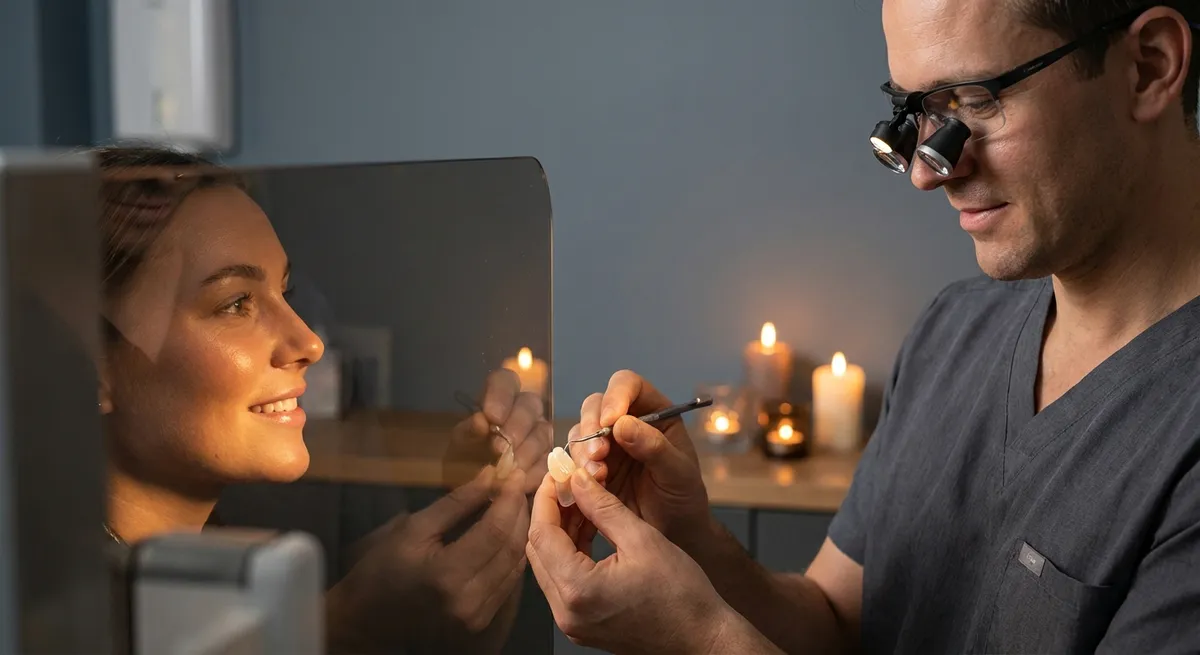
Well-executed provisional restorations are not just placeholders; they are your live, wearable prototype. In elevated practices, temporaries are shaped, refined, and adjusted based on your feedback—how they feel when you speak, how they appear in different lighting, how they photograph. The final ceramics are then crafted to reflect this real-world test drive, rather than a one-time impression of your teeth.
These insights underscore that a premium smile makeover is an iterative collaboration, not a single appointment.
Technology as an Extension of Taste, Not a Replacement
Digital smile design, intraoral scanning, and chairside CAD/CAM milling have transformed what is technically possible. Yet technology alone does not guarantee excellence; it amplifies the taste and judgment of the clinician.
Top-tier practices use technology to:
- Visualize proposed changes through digital mock-ups and overlays on your facial photographs.
- Communicate with master ceramists in exquisite detail, sharing precise instructions on translucency, surface anatomy, and color mapping.
- Ensure consistent precision in fit and margin integrity, which directly affects comfort, longevity, and gum health.
However, the final decisions—how much to lengthen, how bright to go, where to position the incisal edge—remain aesthetic calls, grounded in experience and an understanding of both facial proportions and individual personality. The best outcomes come from a blend of advanced tools and an almost couture-level eye for nuance.
Conclusion
A sophisticated dental makeover is far more than a cosmetic upgrade. It is a calibrated rebalancing of form, function, and facial harmony—executed with an attention to invisible details that only becomes fully apparent over time.
For patients who value refinement, the goal is not to look “done,” but to look unmistakably like themselves—rested, balanced, and quietly elevated. By understanding the subtleties behind materials, bite design, gum architecture, and aging, you can choose a provider and a plan that respect both your present aesthetic and your future self.
In the realm of premium dentistry, excellence is measured not just by how a smile photographs today, but by how gracefully it lives with you in the years to come.
Sources
- American Academy of Cosmetic Dentistry – About Cosmetic Dentistry – Overview of modern cosmetic procedures, materials, and treatment considerations.
- Mayo Clinic – Veneers – Clinical explanation of veneers, indications, and risks that underpin many smile makeovers.
- Cleveland Clinic – Occlusion (Bite) and TMJ Disorders – Discussion of how bite relationships affect jaw health and function.
- National Institutes of Health (NIH) – Ceramic Materials in Dentistry – Research-based review of dental ceramics, their properties, and applications.
- University of Michigan School of Dentistry – Esthetic Dentistry Overview – Academic perspective on esthetic treatment planning and multidisciplinary care.
Key Takeaway
The most important thing to remember from this article is that this information can change how you think about Dental Procedures.