A refined smile no longer relies on a dentist’s intuition alone. Today’s most coveted transformations are quietly engineered—planned with the same precision a couture atelier brings to a custom gown. Smile design has evolved into a discipline that blends digital technology, facial aesthetics, and subtle psychology to create results that feel inevitable, not obvious. For those considering a dental makeover, understanding this more curated approach is the difference between a “nice” smile and one that looks as though it has always belonged to you.
Below are five exclusive, often-overlooked insights that shape truly exceptional smile design—details that the most discerning patients quietly insist upon.
The Smile as a Signature: Designing for Personal Identity, Not Perfection
High-level smile design does not chase generic perfection; it seeks a visual signature that is uniquely yours.
A skilled cosmetic dentist begins with a deep study of your facial language: how you smile when you are unguarded, how your lips move when you speak, where your eyes crease when you laugh. The goal is not to impose a standard “ideal” but to design a dental language that complements your natural expressiveness. In this context, tooth size, form, and texture are not merely aesthetic choices; they become subtle cues that communicate personality—serene, bold, youthful, understated.
Rather than using a one-size-fits-all template, modern practitioners incorporate your age, cultural background, lifestyle, and even the type of image you want to project in professional and social settings. The result is a smile that feels authentic in photographs, in meetings, and in private moments—an extension of your identity rather than an accessory you “put on.”
Beyond White: Nuanced Shade, Translucency, and Texture
To the untrained eye, “whiter” can seem synonymous with “better.” In elite smile design, it is the nuanced play of shade, translucency, and surface texture that quietly signals quality.
Natural teeth are not a single flat color. They present a gradient—slightly deeper at the neck near the gumline, lighter and more translucent toward the edge, often with intricate internal character. Premium ceramic work aims to preserve or emulate these layers rather than erase them. A sophisticated smile design might feature:
- Slightly warmer tones that flatter your skin’s undertone
- Delicately translucent incisal edges that catch the light like natural enamel
- Fine micro-texturing that breaks up reflections, preventing the “plastic” look
The artistry lies in understanding how teeth appear not just under clinical lighting, but in your real life: restaurant candlelight, boardroom fluorescents, afternoon sun. The most successful makeovers look just as convincing in a candid phone snapshot as they do in a studio photograph—and that is almost always the result of meticulously calibrated color and texture, not merely elevated brightness.
The Silent Influencers: Lips, Gum Line, and the “Smile Window”
Elite smile design extends far beyond the teeth themselves. The most discreetly luxurious results come from addressing what could be called the “smile window”—the total frame of lips, gums, and visible tooth structure when you speak and laugh.
A refined treatment plan evaluates:
- Lip support: The projection and fullness of the lips can be subtly enhanced by adjusting tooth position and length, sometimes reducing the need for fillers.
- Gingival aesthetics: An uneven or bulky gumline can visually shorten teeth or unbalance the smile. Laser reshaping or minor periodontal procedures can create a cleaner, more harmonious frame.
- Smile arc: The curvature of the upper teeth should ideally echo the curve of the lower lip when you smile. This seemingly small alignment dramatically affects how youthful and relaxed a smile appears.
By optimizing the frame, not only the content, your teeth sit naturally within your face rather than appearing as a separate, overly conspicuous element. Done well, people will simply remark that you look “rested” or “refreshed” without guessing why.
Precision Planning: Digital Mock-Ups, Test-Drive Smiles, and Reversible Decisions
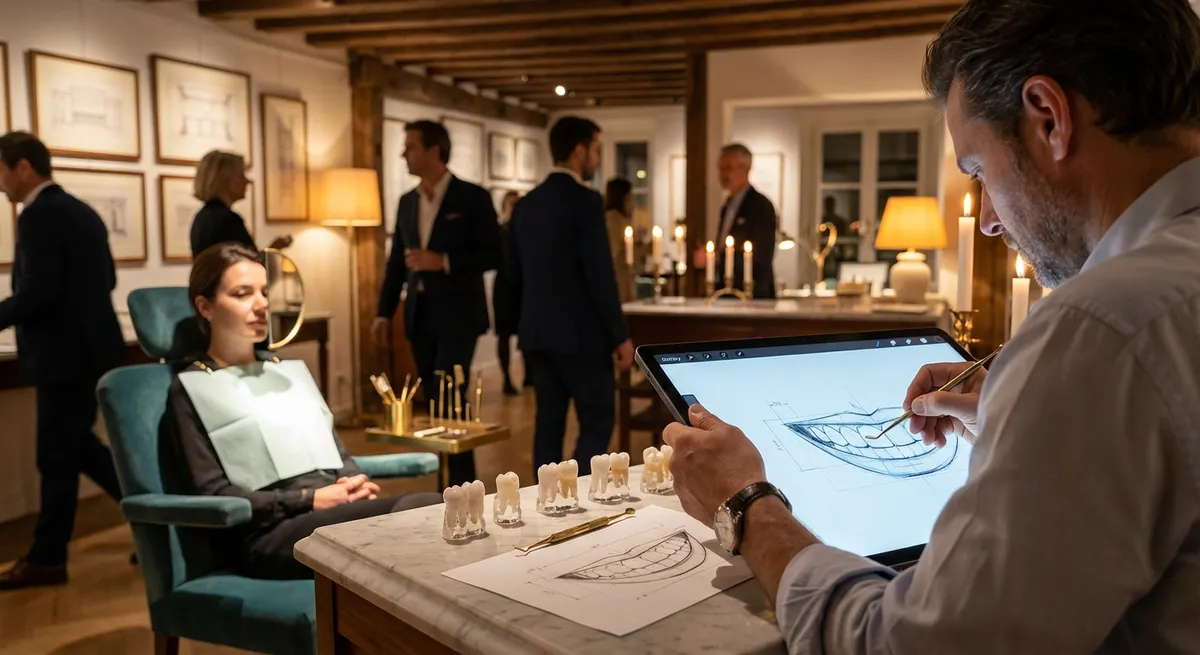
The most reassuring aspect of contemporary smile design is that the final result rarely comes as a surprise. High-end practices now treat smile makeovers like architectural projects—planned, tested, and refined before any lasting changes are made.
Key tools may include:
- Digital Smile Design (DSD): High-resolution photographs and scans are used to simulate potential outcomes on-screen, allowing you and your dentist to evaluate proportions and style together.
- 3D-printed mock-ups: Temporary “test-drive” veneers or overlays can be placed directly over your existing teeth, enabling you to live with the proposed design in real time—speak, eat, smile, and photograph yourself.
- Incremental, minimally invasive steps: Instead of aggressively reducing tooth structure from the outset, conservative approaches allow for subtle adjustments and, where possible, reversibility.
For patients accustomed to curated decisions in other areas of life—wardrobe, interiors, wellness—this process offers a familiar level of control and transparency. You are not merely consenting to treatment; you are co-directing the aesthetic narrative of your smile.
Longevity as a Luxury: Designing for How Your Smile Will Age
True luxury in smile design is not just how it looks next month, but how it will look ten years from now.
Advanced planning accounts for gradual changes in facial volume, lip posture, and tooth wear. Instead of pushing teeth to extreme lengths or ultra-bright shades that may feel incongruent as the face matures, a forward-thinking design aims for:
- A shade that will remain believable as your complexion and hair color evolve
- A tooth length and shape that will still look natural as lips subtly thin or shift
- Materials chosen for durability and color stability, resisting staining and micro-fractures
Equally important is the integration of functional health: ensuring your bite is balanced, your jaw joints are not overburdened, and nightly habits such as clenching or grinding are addressed. A well-designed smile that fractures or causes discomfort is neither elegant nor sustainable. The most successful makeovers pair beauty with biomechanical intelligence, so the smile continues to perform quietly and reliably, day after day.
Conclusion
A sophisticated smile makeover is less about dramatic before-and-after images and more about the quiet assurance that your smile belongs seamlessly to you. Modern smile design is a collaborative, data-informed, and deeply aesthetic process that considers who you are now—and who you will be in a decade.
For those seeking more than a generic “Hollywood” outcome, paying attention to these subtler dimensions—identity, nuance, framing, planning, and longevity—transforms cosmetic dentistry from a procedure into a tailored experience. The result is a smile that does not simply look improved, but feels inevitable: curated, considered, and entirely your own.
Sources
- American Academy of Cosmetic Dentistry – Cosmetic Dentistry Procedures – Overview of cosmetic treatment options and considerations in modern smile enhancement
- Mayo Clinic – Veneers – Clinical explanation of veneers, indications, and risks relevant to smile design planning
- Harvard School of Dental Medicine – Esthetic Dentistry Course Overview – Insight into how advanced programs approach esthetic and functional integration in smile design
- National Institutes of Health (NIH) – Esthetic Smile Perception Study – Research perspective on how dental and gingival factors influence perceived smile attractiveness
- Cleveland Clinic – Cosmetic Dentistry – Patient-focused guidance on cosmetic dental options, durability, and maintenance considerations
Key Takeaway
The most important thing to remember from this article is that this information can change how you think about Smile Design.