A truly refined smile is never accidental. It is curated—quietly, intentionally, and with the same discernment one might bring to commissioning a custom suit or selecting a signature fragrance. Modern smile design has evolved far beyond generic “before and after” transformations. It is now a discipline where digital precision, facial aesthetics, and personal identity converge to create a result that feels effortless, individual, and enduring.
For those contemplating a high-level smile makeover, the distinction lies in details that are often invisible to the casual observer—but unmistakable in the final impression. Below, we explore how contemporary smile design functions as a bespoke service, and share five exclusive insights that sophisticated patients value long before they take a seat in the dental chair.
The New Aesthetic: From “Perfect” to Personally Convincing
The era of the cookie-cutter Hollywood smile is quietly fading. Today’s most coveted smiles do not look “done”; they look convincing—elegant, harmonious, and inextricably linked to the person who wears them.
Instead of chasing a standardized ideal, modern smile design evaluates how your teeth interact with your eyes, lips, skin tone, and even your natural mannerisms. Subtle asymmetries may be preserved, micro-imperfections may be gently refined rather than erased, and tooth shapes are selected not just for beauty but for character.
This shift represents a deeper understanding: a high-end smile makeover is successful only when it feels like a refined enhancement of who you already are, not a visual declaration of what has been altered. The goal is not perfection—but authenticity elevated to its most polished form.
Insight 1: Your Smile Has a “Design Signature”
Every sophisticated makeover begins with a design signature: the unique aesthetic language that will guide every decision, from tooth dimensions to color gradients and proportions.
This design signature is informed by:
- Facial geometry – The relationships among your jawline, cheekbones, nose, and eyes.
- Lip dynamics – How much tooth you show at rest, while speaking, and in a full smile.
- Personality cues – Whether your natural presence reads as soft and understated or bold and commanding.
- Age and lifestyle – The degree of brightness, translucency, and texture appropriate for your stage of life and professional environment.
A more extroverted, on-camera professional might be suited to slightly bolder contours and heightened luminosity, while a discreet executive could benefit from a softer, matte, ultra-natural finish that blends seamlessly in every context.
When a dentist or smile designer speaks about “customization,” the true mark of excellence is not merely selecting a veneer shade. It is the creation of a coherent visual identity for your smile—your design signature—that can be articulated, replicated, and refined with precision.
Insight 2: Tooth Texture and Translucency Are Luxury-Level Details
At the highest level of smile design, two details separate a premium result from a merely attractive one: surface texture and translucency.
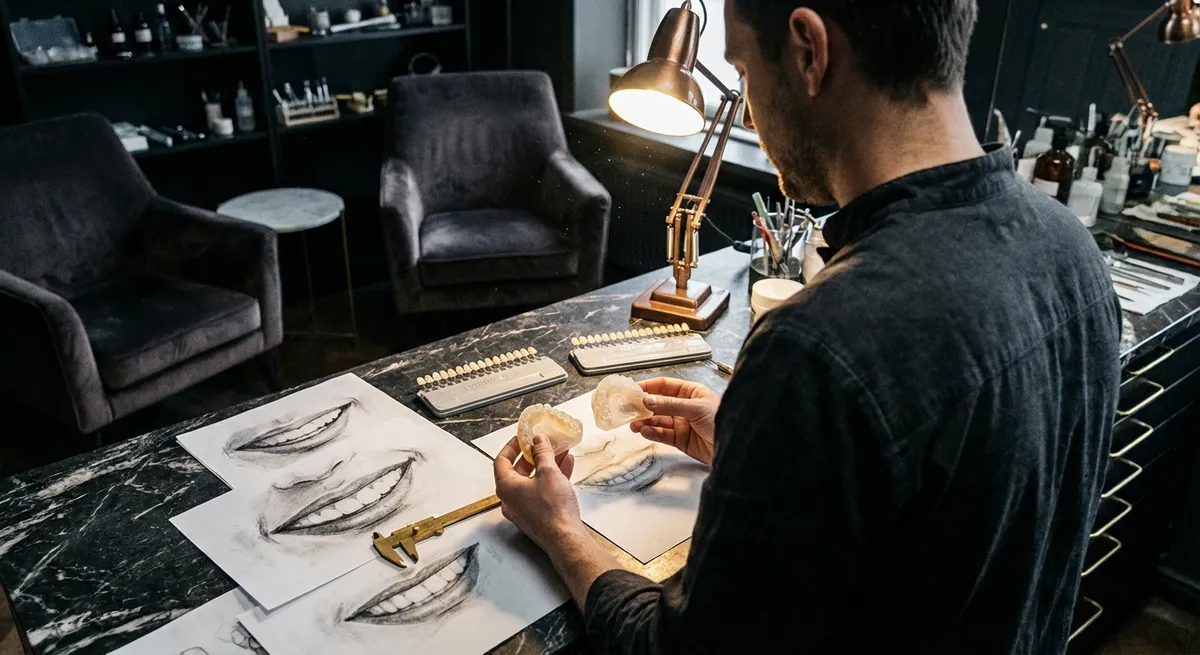
Natural teeth are not uniformly smooth or opaque. They exhibit faint vertical ridges, gently undulating surfaces, and subtle gradations of translucency toward the edges. These micro-characteristics are what allow light to interact with your teeth in a nuanced, lifelike way.
A sophisticated clinician-ceramist team will consider:
- Macro-texture – Overall surface shape to catch or diffuse light across the smile line.
- Micro-texture – Fine lines and soft irregularities that break up reflections, preventing a “flat” or artificial shine.
- Translucent halo and incisal edges – The delicate brightness and slight transparency at the tips, mimicking youthful enamel.
- Gloss level – High-gloss for a luminous, camera-friendly smile; slightly softened gloss for a more natural, understated elegance.
These refinements are rarely discussed in typical consultations, yet they are precisely what give a smile the quiet luxury of looking naturally exquisite rather than cosmetically obvious.
Insight 3: Digital Mock-Ups Are Your Personal Fitting Room
Before commissioning a tailored garment, you would expect a fitting. Contemporary smile design offers its own equivalent: digital mock-ups and prototypes that allow you to “wear” your future smile in advance.
Advanced practices may incorporate:
- Digital Smile Design (DSD) – High-resolution photographs and videos combined with specialized software to map out tooth shapes and positions in relation to your face.
- 3D scans – Scanning your teeth and bite to create a precise digital model of your mouth.
- Photorealistic previews – Simulated images or videos that show how your future smile will appear when you talk, smile, or laugh.
- Trial smiles (provisionals) – Temporaries crafted with your final design in mind, allowing you to test-drive your new look in real life before the definitive restorations are made.
This process is less about novelty and more about control. It allows for subtle adjustments—slightly shortening an incisor, softening a corner, adjusting brightness—before any irreversible steps are taken. For discerning patients, the ability to collaborate visually with their clinician is not a luxury; it is an essential safeguard for a result that feels precisely right.
Insight 4: The Most Successful Makeovers Respect Your Existing Bite
A truly elevated smile makeover is as functional as it is beautiful. Behind every harmonious result is a carefully protected foundation: your bite, or occlusion.
While it can be tempting to focus entirely on color and shape, overlooking how your teeth meet can lead to:
- Microscopic fractures in veneers or crowns
- Jaw tension, headaches, or muscle fatigue
- Tooth wear or chipping over time
- An uncomfortable sense that your teeth “don’t fit together” the way they should
A premium approach to smile design examines how the upper and lower teeth interact in motion—while speaking, chewing, and clenching lightly. This may involve assessing jaw joints, muscle balance, and existing wear patterns.
When necessary, bite is gently rebalanced through selective adjustments, carefully calibrated restorations, or, in some cases, discreet orthodontic movement prior to cosmetic work. The outcome is elegance with longevity: a smile that not only looks refined but feels naturally integrated into the way your mouth already functions.
Insight 5: Color Is Not One Shade—It’s a Palette
The most sophisticated smiles are not defined by “white” alone. They are built from a curated palette of shades, values, and undertones—chosen to interact gracefully with your complexion, eye color, and even the way you dress.
Refined color work considers:
- Value (brightness) – How light or dark the tooth appears, separate from its hue.
- Hue (color family) – Subtle warm or cool undertones that should complement your skin tone, not fight it.
- Chroma (intensity) – The strength or softness of color, which influences whether a smile looks bold or understated.
- Gradient – Slight variations from the gumline to the edge, mimicking natural teeth where enamel is not uniformly one color.
For example, a porcelain that is too bright and cool on warm, olive-toned skin can appear stark and unnatural. Conversely, a slightly warmer shade with delicately layered translucency can appear luminous without announcing itself.
An experienced smile designer will often layer different porcelain powders or composite materials to achieve this effect, building dimension rather than applying a single, flat color. The result is a smile that photographs beautifully under studio lights yet remains discreetly believable in everyday settings.
Insight 6: Lip Support and Facial Balance Are Part of the Design
A smile exists within a frame: your lips, perioral tissues, and surrounding facial structures. High-level smile design does not ignore this frame—it works in partnership with it.
Expert clinicians evaluate:
- Lip support – How the front teeth and veneers gently support the lips, subtly influencing fullness and contour.
- Smile arc – The curvature of the upper teeth relative to the curve of the lower lip during a natural smile.
- Gingival display – How much gum tissue shows and whether it appears balanced, smooth, and symmetrical.
- Vertical dimension – In certain cases, slight changes in tooth length can rejuvenate the lower third of the face, softening collapsed or aged contours.
This is where smile design subtly intersects with facial aesthetics. The goal is not to change your face, but to refine it—restoring or enhancing proportion in a way that can make you appear more rested, open, and energized, without any obvious marker of “cosmetic work.”
Conclusion
A sophisticated smile makeover is not defined by the number of veneers, the price tag, or even the immediate visual impact. Its true value lies in the orchestration of microscopic details—texture, translucency, bite harmony, color nuance, and facial balance—into a single, cohesive expression of who you are.
Modern smile design, at its best, is not a transformation in the theatrical sense. It is a considered curation of your natural attributes, elevated through technology, artistry, and an unwavering respect for subtlety. For those who seek results that whisper rather than shout, the journey begins not with “How white can we go?” but with a more nuanced question:
“How can we design a smile that feels unmistakably, effortlessly, and enduringly yours?”
Sources
- American Academy of Cosmetic Dentistry – About Cosmetic Dentistry – Overview of modern cosmetic dentistry principles and treatment options
- Digital Smile Design (DSD) – Official Concept Overview – Explains the philosophy and workflow behind digital smile design and mock-ups
- Mayo Clinic – Malocclusion (Bad Bite) – Describes the importance of bite alignment and its impact on function and comfort
- Harvard School of Dental Medicine – Esthetic Dentistry Research – Highlights ongoing research in esthetic and restorative dentistry
- Cleveland Clinic – Dental Veneers: What to Expect – Provides evidence-based information on veneers, materials, and outcomes
Key Takeaway
The most important thing to remember from this article is that this information can change how you think about Smile Design.