In elevated aesthetics, a smile is no longer a simple “before and after” photograph—it is a curated asset, tailored as meticulously as a bespoke suit or a custom piece of jewelry. Today’s discerning patients are not looking for a generic Hollywood grin; they are seeking a smile that feels innately theirs: proportioned to their features, harmonious with their personality, and resilient in real life, not just in studio lighting. This is the quiet evolution of smile design: an intimate, data‑driven, and highly personal collaboration between patient and clinician.
Below are five exclusive insights that shape this new era of refined smile makeovers—insights that rarely appear on treatment menus, yet define the difference between a good result and a truly exceptional one.
The Signature Line: Designing the Smile to Follow Your Natural Narrative
In sophisticated smile design, the first question is not, “What shade do you want?” but, “What story should your smile tell?” Every feature—your lip curve, midface symmetry, even the way your eyes narrow when you laugh—contributes to what elite clinicians often call your “signature line”: the visual path the viewer’s eye follows across your face.
Rather than chasing a single, idealized template, a curated smile respects this natural narrative. Slight variances in incisor length, a hint of asymmetry, or a gentle rounding of the canine can be chosen not as compromises, but as deliberate design elements that echo your natural anatomy. We are no longer in the realm of erasing individuality; the goal is to refine your existing visual language, not overwrite it.
The most advanced clinicians use high-resolution photography and dynamic video capture to study how your teeth and lips move during real speech and laughter. From there, they design a smile that looks as convincing in motion as it does in still images. The result is a “quietly right” appearance—so congruent with your face and personality that it feels less like a makeover and more like an unveiling.
Chromatic Harmony: Beyond “White” to Layered, Luminous Color
Those who only ask for “the whitest possible shade” are missing the deeper language of color in smile design. Natural enamel is not flat white; it is an interplay of translucency, halo effects at the edges, subtle warmth toward the gumline, and delicate internal characterization. High-end dentistry treats color as a spectrum, not a single number on a shade tab.
Elite ceramists work with layered porcelains that mimic the way real enamel handles light—absorbing, reflecting, and scattering it with nuance rather than gloss. A slightly warmer incisal third may soften a very fair complexion; a more translucent edge can keep a bright smile from looking opaque under flash photography. Shade selection becomes about chromatic harmony with your skin tone, sclera (the white of your eyes), and lip color, not simply “brighter.”
Furthermore, lighting conditions are deliberately considered. A smile that appears perfectly balanced under clinical lights may look flat outdoors or overly reflective on camera. Sophisticated teams now calibrate shade and translucency using cross‑lighting, natural daylight, and even video testing, ensuring the final result remains believable and elegant in the environments where you actually live, work, and socialize.
Micro‑Proportions: Millimeter Decisions with Outsized Impact
While public conversations about smile design often stop at “straight and white,” the true luxury lies in micro‑proportions—the millimeter-level decisions that shape how refined your result appears. The golden proportions between central incisors, lateral incisors, and canines are only the starting point. High-end smile designers adjust these ratios to your unique lip line, facial width, and age.
Subtle contouring of incisal edges can transform the expression of a smile from assertive to soft, youthful to timeless. Slightly squarer centrals may project confidence and authority; gently rounded corners and a softened midline can feel more approachable. The gingival architecture—the contour of the gumline around each tooth—plays a critical role as well. A fraction of a millimeter of tissue reshaping can make veneers look like they “belong” rather than simply “fit.”
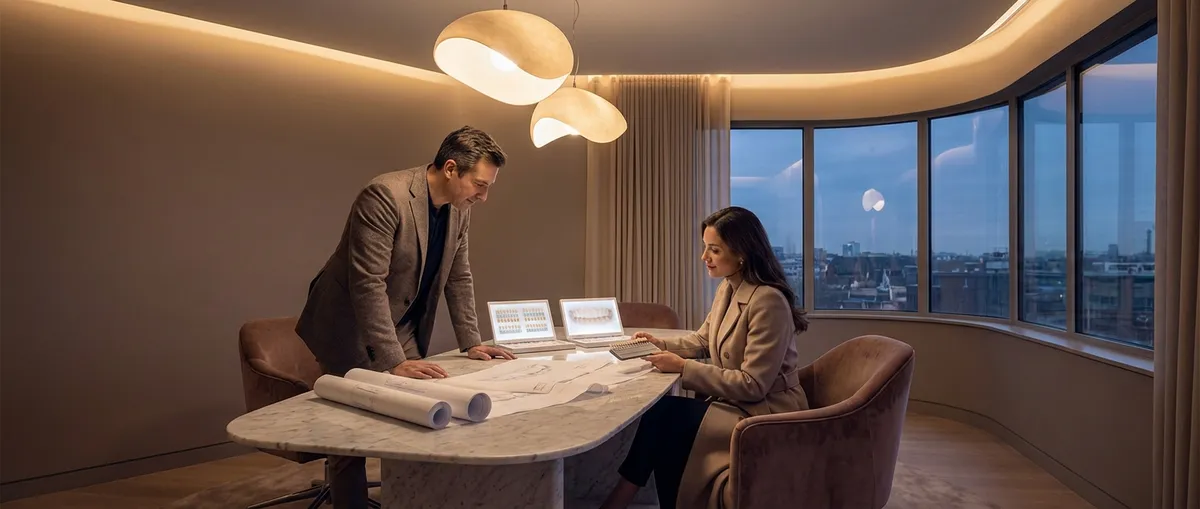
This micro‑precision often involves magnification, digital design software, and meticulously crafted mock‑ups that you can trial in your own mouth before any definitive treatment begins. For the patient, this level of detail means fewer surprises: a smile that looks as refined in a candid photograph as it does in the mirror, without the telltale “done” look that undermines otherwise expensive work.
Lifestyle Mapping: Designing a Smile for the Way You Actually Live
One of the most overlooked luxuries in smile design is the consideration of how you live, work, and play. Two patients might request a similar aesthetic, yet require entirely different material choices and structural strategies based on lifestyle.
A keynote speaker, constantly under stage lighting and high-definition cameras, may prioritize color stability and minimal surface glare. A wine enthusiast or avid coffee drinker needs materials and surface finishes that resist long‑term staining without requiring aggressive polishing. Those who grind or clench at night—often high‑performing professionals—demand reinforced designs, protective night guards, and occlusal schemes engineered to distribute forces safely.
Lifestyle mapping also includes your appetite for maintenance. Some patients are delighted to return for regular professional polishing and periodic refinements; others prefer a design that stays quietly impeccable with minimal intervention. The best clinicians don’t simply ask what you want your smile to look like on day one—they engineer it for how you intend to live with it over the next decade.
Collaborative Craftsmanship: Why the Ceramist Matters as Much as the Dentist
In luxury smile design, your result is rarely the work of a single pair of hands. Behind every seemingly effortless set of veneers or crowns there is often an elite dental ceramist, functioning very much like a couture atelier interpreting a designer’s sketch. The dentist orchestrates the vision, functional blueprint, and biological health; the ceramist sculpts the final expression in ceramic.
This collaboration is where subtleties are refined: surface texture that mimics natural enamel, minute variations in translucency between neighboring teeth, and handcrafted internal effects that keep the smile from appearing “flat” on camera. High-end practices may send your photographs, facial scans, and even video clips to the laboratory so the ceramist can see you as a whole person, not just as a set of dental impressions.
For patients seeking exceptional results, asking about the lab is as important as asking about the dentist. Is the work done by a master ceramist or outsourced to a volume‑based facility? Does the team allow for in‑person shade matching and custom staining, or even a visit to the lab for final refinements? This level of collaborative craftsmanship is often the invisible line between a good cosmetic result and a genuinely bespoke one.
Conclusion
A truly elevated smile makeover is not defined by how dramatically it changes your appearance, but by how precisely it aligns with who you are. From the signature line that guides the viewer’s eye, to chromatic harmony, micro‑proportions, lifestyle mapping, and the often‑unseen artistry of the ceramist, refined smile design is a study in quiet detail.
For those considering a transformation, the most powerful question you can ask is no longer, “Can you make my teeth look better?” but, “Can we design a smile that feels authentically mine—and beautiful from every angle of my life?” When your dental team answers that with data, artistry, and restraint, you are no longer purchasing a procedure. You are commissioning a piece of living design.
Sources
- American Academy of Cosmetic Dentistry – About Cosmetic Dentistry - Overview of modern cosmetic dentistry principles and treatment options
- Mayo Clinic – Veneers - Clinical explanation of veneers, indications, and considerations
- Columbia University College of Dental Medicine – Esthetic Dentistry - Academic perspective on esthetic and restorative dental procedures
- National Institutes of Health (NIH) – Optical Properties of Dental Ceramics - Research discussion of translucency, color, and light behavior in ceramic materials
- UCLA School of Dentistry – Digital Dentistry and Smile Design - Insight into digital workflows and advanced planning in smile design
Key Takeaway
The most important thing to remember from this article is that this information can change how you think about Smile Design.