Smile design today has less to do with “perfect teeth” and far more to do with creating a face-specific signature—one that feels natural in photographs, on video calls, and in the fleeting, unguarded moments of real life. For discerning patients, the goal is not a generic Hollywood smile but an expression that feels innately theirs, simply elevated. This is the domain of contemporary smile design: a meticulous, technology‑assisted, yet profoundly human craft.
From Teeth to Portrait: Designing for the Whole Face
True smile design does not begin with enamel; it begins with the person.
An accomplished cosmetic dentist studies the entire facial composition: the interplay of lips, cheeks, eyes, and even posture. Lip mobility during speech, the way the cheeks lift when you laugh, and the natural head tilt you adopt in candid photos all inform the ideal tooth length, brightness, and contour. Rather than chasing a universal “ideal,” the clinician is sculpting within your existing facial architecture.
Digital smile design tools now allow a dentist to overlay proposed changes on high‑resolution photos and video clips of you speaking and smiling. Instead of assessing a still image alone, the dentist can see how proposed proportions behave in motion. The result is not just a pleasing set of teeth, but a smile that looks convincing from every angle—in a boardroom, in evening light, and under the unforgiving clarity of 4K video.
Five Exclusive Insights for a Truly Bespoke Smile Makeover
Beyond the usual advice about whitening and veneers, there are subtler considerations that quietly distinguish an ordinary result from a refined transformation. Patients who appreciate nuance tend to consider these five insights early in the process.
1. Micro‑Asymmetry Is Your Best Friend
Absolute symmetry often looks artificial. The most captivating smiles typically include tiny, intentional irregularities: a subtle variation in the shape of the lateral incisors, a whisper of difference in contour between right and left canines, or a barely perceptible variation in translucency at the edges.
A skilled dentist will preserve, or even introduce, micro‑asymmetries to maintain a human, unmanufactured quality. When reviewing mock‑ups, ask your dentist where they have allowed these small divergences. If everything looks too uniform on screen, that may translate as “overdone” in person.
2. Your Smile Has a “Dress Code” for Different Settings
For many patients, the smile must perform across very different environments: clinical office lighting, warm restaurant interiors, stage or studio lighting, and the gentle glow of home. Ultra‑bright shades that appear dazzling in a dental chair can read as harsh or opaque in softer conditions.
Discuss with your dentist where your smile “lives” most of the time—on camera, in client meetings, in social evenings. Together, you can calibrate shade and translucency so that your teeth appear luminous in real life without looking over‑processed in photographs. Think of it as a dress code: not black tie, not casual, but a level of polish that feels correct everywhere you go.
3. Enamel Texture Matters More Than You Think
The surface texture of teeth—those delicate vertical striations and micro‑undulations—carries enormous visual information. Highly polished, glassy veneers can reflect light in a way that instantly signals “cosmetic work,” particularly under flash photography or strong down‑lighting.
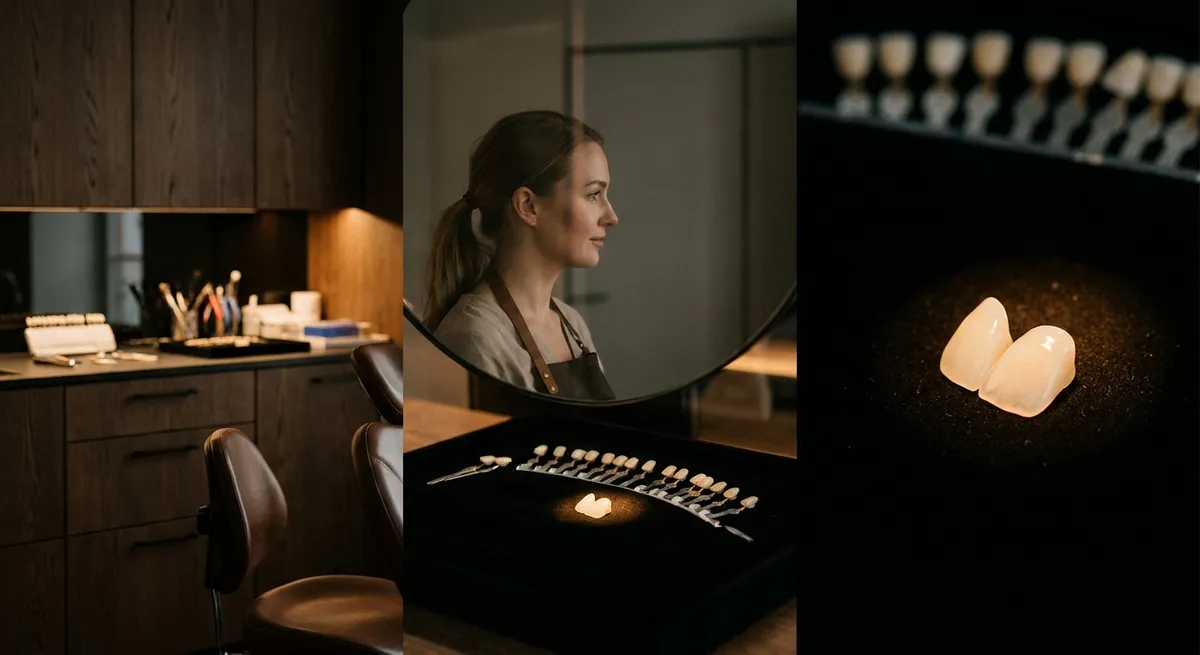
Modern ceramic work can mimic the faint, irregular texture of youthful natural enamel, softening reflections and adding depth. When you review prototypes or try‑in veneers, look at them under varied lighting: natural daylight, bathroom lighting, and night‑time indoor lighting. Ask your dentist specifically about enamel texture and light diffusion; this is where elite laboratory craftsmanship becomes most apparent.
4. Your Speaking Patterns Shape the Design
Smile design is as much about sound as appearance. Altering tooth length or position—even by a millimeter—can subtly change how you pronounce certain consonants, especially “S,” “F,” and “V” sounds. For individuals who speak publicly, host podcasts, or spend significant time on conference calls, this detail is non‑negotiable.
Advanced practices will record you speaking with provisional restorations and adjust length or contour to refine phonetics before any final work is fabricated. Do not hesitate to bring sample recordings (presentations, interviews, or voice notes) to your consultation; this allows your dentist to appreciate how your smile must serve your voice and your professional identity.
5. The Most Successful Makeovers Are Phased, Not Rushed
While dramatic “weekend transformations” are heavily marketed, the most elegant results typically emerge from a carefully phased approach. Temporary prototypes, or “trial smiles,” allow you to live with a proposed design for days or weeks—smiling, chewing, speaking, and simply seeing yourself in the mirror.
This phase offers a rare opportunity: you can fine‑tune shapes, lengths, or shade before any irreversible steps are taken. You may discover that a slightly softer incisal edge or a more understated brightness better suits your features and personality. A premium outcome is rarely a single dramatic reveal; it is a deliberate progression of subtle corrections leading toward an end result that feels inevitable.
The Silent Language of Proportion and Personality
Behind every remarkable smile lies a quiet grammar of proportion. Dentists reference classical esthetic principles such as the “golden proportion,” but the modern mindset treats these as guidelines, not commandments. For some faces, a slightly wider central incisor communicates confidence; for others, a softer, more rounded profile feels more authentic.
Personality, too, is encoded in the design. More squared, prominent teeth often telegraph authority and assertiveness; more rounded contours imply approachability and softness. The art lies in tailoring these visual cues to your own self‑image—and to how you wish to be perceived in professional and intimate settings.
The dentist’s role is part clinician, part portrait artist, and part strategist. They are not only repairing or beautifying; they are translating your preferences, lifestyle, and aspirations into lines, planes, and light reflections that quietly communicate who you are.
Curating Your Team and Your Outcome
For patients seeking refined, long‑lasting results, the choice of clinician and laboratory is as critical as any design decision. Look for practitioners who:
- Use high‑resolution photography and video, not just basic intraoral images
- Collaborate with top‑tier dental ceramists rather than generic laboratories
- Encourage a provisional phase and invite your feedback on feel and aesthetics
- Discuss long‑term maintenance, including night guards, hygiene, and longevity of materials
During consultation, the most telling sign is the nature of the questions you are asked. A dentist who inquires about your work environment, how often you appear on camera, your tolerance for visible change, and which historical photos of yourself you like best is already thinking beyond teeth. They are designing an expression, not a product.
In this context, smile design becomes less a procedure and more a curated experience: a thoughtful, collaborative process that culminates not in a “new you,” but in a more coherent, more confident version of the person you already are.
Conclusion
A truly elevated smile makeover is defined not by its drama but by its discretion—the way it feels instantly “right,” as though it has always belonged to you. When you weigh micro‑asymmetry over artificial perfection, prioritize texture and proportion, honor your voice and speaking patterns, and embrace a phased approach, the result is a smile that performs beautifully in every setting, yet never announces itself.
In the end, modern smile design is less about achieving an aesthetic ideal and more about aligning form, function, and identity. Done well, it is one of the rare investments that subtly enhances every interaction, every introduction, and every moment you choose to step fully into view.
Sources
- [American Academy of Cosmetic Dentistry – What Is Cosmetic Dentistry?](https://aacd.com/whatis) - Overview of cosmetic dentistry principles, including smile design and esthetic considerations
- [Journal of American Dental Association – Patients' Esthetic Expectations and Satisfaction](https://jada.ada.org/article/S0002-8177(14)00081-5/fulltext) - Research on patient expectations, symmetry, and satisfaction with dental esthetics
- [Harvard School of Dental Medicine – Digital Technologies in Dentistry](https://hsdm.harvard.edu/news/digital-dentistry-transforming-patient-care) - Discussion of digital tools and their role in planning and executing smile designs
- [National Institutes of Health – The Impact of Smile Aesthetics on Self-Perception](https://www.ncbi.nlm.nih.gov/pmc/articles/PMC5455326/) - Study examining how smile appearance influences confidence and social perception
- [Mayo Clinic – Veneers and Dental Restorations Overview](https://www.mayoclinic.org/tests-procedures/dental-veneer/about/pac-20384980) - Clinical explanation of veneers and restorative options commonly used in smile makeovers
Key Takeaway
The most important thing to remember from this article is that this information can change how you think about Smile Design.