When Miley Cyrus’s new smile started trending, the internet did what it always does—zoomed in, speculated wildly, and debated whether she “changed too much” or “finally looks like herself again.” But beneath the noise is a quietly important story: a high-profile, extremely public figure choosing to refine her smile in a way that feels more authentically her—and doing it in 2025, when cosmetic dentistry is under more scrutiny, and more sophisticated, than ever.
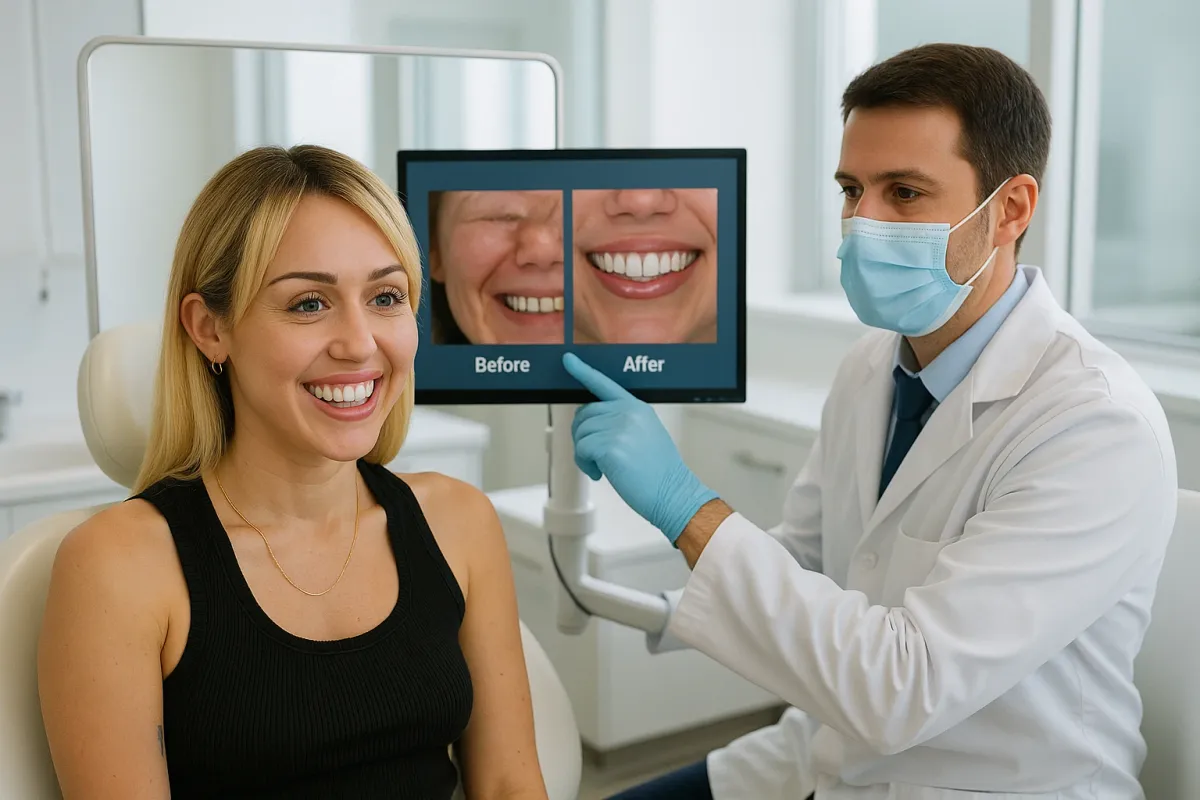
For anyone considering a dental makeover—whether subtle refinements or a full, Hollywood-level transformation—Miley’s viral before-and-after offers a rare, real-time masterclass. Her new look reflects where elite cosmetic dentistry is headed: away from one-size-fits-all “veneers smiles,” and toward bespoke, face-harmonizing, lifestyle-matched design.
Below, we decode five exclusive insights hidden in this very public transformation—precisely the details discerning patients are now asking about behind closed doors in top-tier cosmetic practices worldwide.
1. The Era of the “Signature Smile” Is Over
What viewers responded to in Miley’s updated smile wasn’t just that it looked “better”—it looked less generic. For years, celebrity dentistry was dominated by the “studio smile”: ultra-white, ultra-symmetrical veneers that could belong to almost anyone. The outcome? A wave of faces that looked polished, but oddly interchangeable, especially in high-definition closeups.
Miley’s new smile appears softer, more proportionate to her facial features, and crucially, less like a dental template. This aligns with a major shift we’re seeing in luxury dentistry: the move from “perfect” to personalized. Dentists at the top of their field are no longer asking, “How do we make these teeth flawless?” but rather, “How do we make these teeth look like they belong to you—at your best?”
That philosophy changes everything: tooth length is tailored to your lip dynamics, incisal edges echo your facial angles, and micro-asymmetries are sometimes intentionally preserved so that your smile retains character. In premium clinics, you’re no longer buying a product; you’re commissioning a signature piece of design—one that never reads as “Oh, she got veneers,” but instead as, “She looks incredible… what changed?”
2. Reversing Overdone Work Is the New Luxury
The buzz around Miley’s “glow returning” after she “got rid of them” taps into a reality many people don’t realize until years after their first makeover: sometimes, the most powerful procedure isn’t adding more—it’s removing, refining, and upgrading.
Patients who rushed into bulky, opaque veneers or aggressive reshaping in the 2010s are now quietly consulting elite dentists to have those restorations replaced or reversed. This is especially true for public figures whose faces have been archived by the internet from every angle and era.
The best practices today are deeply conservative with natural enamel. When previous dentistry has been too aggressive or too visible, elite clinicians may:
- Replace old veneers with ultra-thin, high-translucency porcelain that lets underlying tooth structure shine through.
- Refine the gumline with laser or microsurgical techniques to correct that “heavy” or “boxy” look.
- Shift from a block-white shade to a more nuanced, layered color gradient that mimics natural enamel.
- Strategically shorten or slightly soften teeth that were previously too long or too square.
In other words, the new luxury is undoing anything that makes your dental work obvious. If you’ve ever looked at a photo and thought, “My teeth enter the room before I do,” you’re not imagining it—and it can be redesigned. Miley’s trajectory illustrates that a second-generation makeover can look drastically more natural, even more youthful, than the first.
3. Modern Smile Design Starts With Motion, Not Just Photos
Fans noticed that Miley’s new smile looked particularly good in motion—speaking, laughing, performing—not just in curated stills. That’s no accident. The most advanced cosmetic planning in 2025 relies on video-based and 3D facial analysis, not just a static impression and a single front-facing photo.
Premium practices are now routinely using:
- Dynamic smile analysis: Short video clips of you talking, laughing, singing, or delivering a presentation allow your dentist to see how much teeth you show at rest, how your lips move, and where your smile peaks.
- 3D facial scanning: This maps your facial proportions, midline, and profile to ensure your teeth harmonize from every angle—not just head-on.
- Digital mock-ups and trial smiles: Before anything permanent is done, you may test-drive your new smile with provisional restorations or digitally overlaid designs that you can review in photos and video.
For high-profile individuals like Miley, who live under the lens, this is non-negotiable. But it’s increasingly accessible to discerning patients who understand that a smile has to work in real life, not just in a mirror.
When you’re interviewing cosmetic dentists, don’t just ask to see “before-and-after photos.” Ask:
- “Do you evaluate my smile in motion?”
- “Can I see a digital or provisional preview before we finalize?”
- “How do you ensure harmony between my teeth, lips, and facial structure?”
The most refined results, like the ones now trending on your feed, are almost never accidents—they are rehearsed, iterated, and perfected before a single tooth is definitively altered.
4. Subtle Color Choices Separate High-End From High-Definition
One of the reasons fans commented that Miley looks “more like herself” again may be color—an element that’s chronically underestimated by patients, yet obsessively controlled by elite labs and dentists. Ultra-white, flat-toned teeth may look impressive on a filter-heavy selfie; under studio lights, they can look artificial, reflective, and almost plastic.
Today’s top cosmetic workflows treat shade as an art form. Instead of a single, opaque “BL” shade, advanced restorations are designed with:
- Gradual translucency from neck (near the gums) to edge, just like natural enamel.
- Micro-texture and gloss control, so the surface doesn’t reflect light like a piece of ceramic tile on camera.
- Soft warmth or coolness tuned to your skin undertone, lip color, and typical makeup palette.
- Slight variation tooth-to-tooth, so they read as real, not like a uniform row of piano keys.
In celebrity dentistry, this has become non-negotiable—because cameras are unforgiving, and fans can spot “caps” from a mile away. If you’re pursuing a high-level makeover, insist on a shade consultation that includes natural light, indoor lighting, and photos. Ask your dentist:
- “Will my veneers have layered, custom staining and translucency, or a single tone?”
- “Can we test how the shade photographs on me before final bonding?”
The most premium smiles today aren’t the whitest. They’re the ones that look expensive without announcing themselves.
5. Authenticity Is Now a Clinical Goal, Not Just a PR Story
The narrative around Miley’s new smile—fans saying she “finally looks like herself again”—signals a deeper cultural shift. We’ve moved from celebrating transformation at any cost to valuing recognizability and authenticity. In the treatment room, this has changed the conversation. Patients no longer arrive asking to “look like” someone else. They are asking, increasingly and directly, “Can we do this without erasing me?”
High-end cosmetic dentists are responding with:
- Identity-preserving design: Maintaining the essence of your original tooth shape while refining proportion, symmetry, and health.
- Respect for age and life stage: Avoiding “over-youthful” designs that look at odds with the rest of your face, opting instead for a timeless, age-appropriate elegance.
- Collaborative planning: Multiple design previews, open discussions about fears (looking fake, looking different, being “found out”), and gradual changes when desired.
- Functional integrity: Ensuring that TMJ health, bite stability, and long-term comfort are built into the plan—not sacrificed for a quick visual win.
When a celebrity emerges with a refreshed smile and fans say, “She looks like herself, just elevated,” that’s not just good PR; it’s a signal that her clinicians prioritized identity over spectacle. In 2025, the most coveted outcome isn’t a brand-new face—it’s a face the world already loves, refined with restraint.
Conclusion
Miley Cyrus’s newly viral smile is not just another celebrity makeover; it’s a snapshot of where elite dental aesthetics now stand—smarter, softer, and far more personal than the high-gloss, high-uniformity era that came before. Behind the trending clips and side-by-side comparisons lies a reassuring truth for anyone contemplating a dental transformation: the best cosmetic dentistry in 2025 isn’t about making you unrecognizable. It’s about bringing you into focus.
If you’re considering your own smile upgrade, let this moment in pop culture guide your questions, not your insecurities. Ask for motion-based design, layered color, enamel-respecting techniques, and above all, a result that still looks like you—just as the world has always imagined you at your most confident.
Because in the most refined practices today, the real goal is no longer a “perfect” smile. It’s a convincing one—so impeccably tailored that people don’t ask who did your teeth. They simply wonder why you suddenly look so effortlessly, unmistakably radiant.
Key Takeaway
The most important thing to remember from this article is that this information can change how you think about Dental Procedures.