A refined smile is never an accident. Behind every seemingly effortless result lies an orchestration of clinical precision, aesthetic judgment, and technical craft. For patients considering a dental makeover, understanding what truly differentiates a “nice” result from an exceptional one is the quiet advantage few people discuss openly. This isn’t about trend‑driven transformations; it’s about calibrated decisions that respect facial harmony, long‑term oral health, and a sense of understated elegance.
Below are five exclusive insights that reveal what actually happens behind the scenes of premium dental procedures—and how to recognize when your smile is being treated as a work of precision aesthetics, not a standard clinical case.
1. Your Bite Is the Invisible Architecture of Every Aesthetic Choice
Most patients arrive asking about whiter, straighter, or more even teeth. Clinicians at the highest level, however, start by evaluating your bite. Occlusion—the way your upper and lower teeth meet—is the unseen framework that determines the stability, comfort, and longevity of nearly every cosmetic procedure.
A misaligned bite can silently chip porcelain veneers, crack composite bonding, and accelerate gum recession. Premium providers will often begin with a detailed bite analysis: mounted study models, digital jaw tracking, or CBCT imaging to assess joint health and bone structure. This can lead to subtle bite adjustments, orthodontic refinement, or selective reshaping before any visible aesthetic work begins.
The result is less dramatic at first glance, but profoundly important over time. When your bite functions harmoniously, restorations age more gracefully, your jaw muscles stay more relaxed, and post‑treatment sensitivity and headaches are far less likely. The most sophisticated smiles are built on bite stability first, esthetics second—never the other way around.
2. Shade Is Only One Dimension: The Quiet Nuances of Light, Texture, and Translucency
Patients often ask, “What shade of white should I choose?” In premium cosmetic dentistry, that question is only the starting point. The true art lies in how a restoration behaves in different kinds of light, and how well it mimics the layered complexity of natural enamel.
Master ceramists and detail‑oriented clinicians consider:
- Translucency: Natural teeth are not opaque. The incisal (edge) area often allows light to pass through. Overly opaque crowns or veneers can look dull and artificial, especially in daylight or in photographs.
- Gradient of color: Natural teeth subtly shift in hue from the gumline to the edge. High‑end restorations recreate this gradient instead of using a flat, uniform shade.
- Surface texture: Micro‑texture and gloss level affect how light reflects off the tooth. A carefully textured surface can diffuse light elegantly, giving the tooth a youthful but not plastic shine.
- Fluorescence: Natural teeth fluoresce under certain lighting (such as club or event lighting). Premium ceramics can be matched to behave similarly, so your smile remains convincing in every environment.
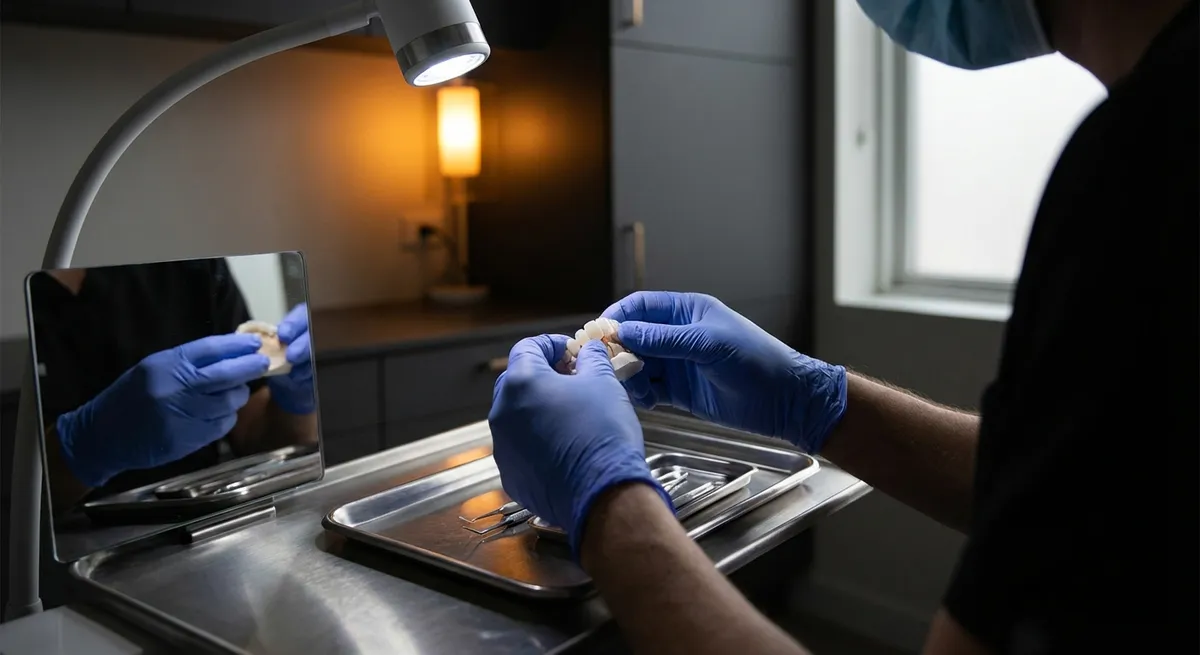
In practice, this means that your dentist may insist on custom shade‑matching with the ceramist, photographs under different lighting conditions, or even a “try‑in” appointment to view provisional restorations in natural light. This attention to optical detail separates a merely white smile from one that reads as naturally luminous—and quietly expensive.
3. Trial Smiles: Why Exceptional Results Are “Prototyped” Before Commitment
In many high‑end practices, you will never jump directly from consultation to final veneers or crowns. Instead, you experience an interim phase sometimes called a “trial smile” or provisional design—a temporary version of your future teeth that you wear in daily life.
Far from being a simple placeholder, this phase is essentially a live prototype. It allows you and your dentist to evaluate:
- The length of the teeth when you speak and smile
- Support of the lips and lower face profile
- How the new shapes influence certain sounds (like “S,” “F,” and “V”)
- Chewing comfort and bite balance
- How the design photographs and appears on video
Quiet refinements—shortening a millimeter here, softening a corner there, adjusting the midline—are made before any final ceramics are produced. This prevents regret and avoids the feeling that you’ve been “handed” a smile you must simply accept.
The most elevated makeovers treat this provisional stage as a non‑negotiable design rehearsal, not an optional extra. If your dentist invests time and care into this phase, it is a strong indicator that your outcome is being curated rather than rushed.
4. Gum Contours and Pink Aesthetics: The Frame That Defines the Picture
Teeth tend to receive all the attention, but in refined smile design, the gums are the frame that give everything its visual coherence. Uneven gum levels, excess gum display (“gummy smile”), or asymmetrical tissue contours can make even beautifully crafted teeth appear off‑balance.
Premium dental procedures frequently involve:
- Gingival recontouring with laser or microsurgical techniques to create symmetrical scallops around the front teeth
- Crown lengthening when short‑looking teeth are actually hidden by excess gum or bone coverage
- Soft tissue grafting to correct recession, dark root surfaces, or black triangles between teeth
- Careful preservation of papillae (the little triangles of gum between teeth) to avoid gaps that age the smile
The goal isn’t to create hyper‑perfect “pink aesthetics,” but rather to establish graceful, balanced proportions between teeth and gums. Well‑executed gum contouring often makes teeth look longer, slimmer, and more elegant—without adding aggressive dental work. When the soft tissue architecture is thoughtfully shaped, the overall impression is one of natural symmetry rather than obvious intervention.
5. Longevity as a Design Principle, Not an Afterthought
Discerning patients increasingly ask not only “How will it look?” but “How will it age?” World‑class dental work is planned with a 10‑ to 20‑year horizon in mind, taking into account how both materials and your own biology will change over time.
Sophisticated treatment planning considers:
- Material selection tailored to your bite and habits: For example, using more resilient ceramics or layered techniques for patients who clench or grind.
- Conservative preparation: Removing as little natural tooth structure as possible to preserve strength and options for future refinements.
- Periodontal stability: Ensuring gums and bone are healthy and stable before placing definitive restorations, to minimize future recession or dark margins.
- Maintenance strategy: Building a realistic plan for professional cleanings, bite checks, night guards, and occasional polishing so the work looks fresh, not overhauled.
The most successful makeovers are designed to transition gracefully through life stages: subtle enough not to date, robust enough to withstand daily function, and adaptable enough to be updated without starting over. When your dentist speaks in terms of “phasing,” “future‑proofing,” or “keeping retreat options open,” you’re likely in the hands of someone who views your smile as a long‑term collaboration, not a one‑time project.
Conclusion
A truly elevated dental makeover is not defined by how much is done, but by how intelligently each procedure earns its place in the overall plan. Behind the polished final result are decisions about bite architecture, optical nuance, trial phases, gum aesthetics, and long‑term resilience—most of which the casual observer will never notice, but everyone will sense.
As you explore your options, listen closely not just for promises of whiter, straighter, or faster results, but for the kind of questions your dentist asks: about your bite, your habits, your facial features, your long‑term expectations. Those conversations are where precision aesthetics begin, and where an impeccable smile quietly takes shape.
Sources
- American Dental Association – Veneers – Overview of veneer procedures, indications, and considerations
- Mayo Clinic – Dental Crowns – Explains crown types, preparation, and longevity factors
- Columbia University College of Dental Medicine – Occlusion & TMD – Discusses bite relationships and their role in jaw comfort and function
- Harvard School of Dental Medicine – Periodontal Health – Details the importance of gum and bone health in overall and oral outcomes
- Cleveland Clinic – Gum Contouring – Describes indications, techniques, and recovery for reshaping the gum line
Key Takeaway
The most important thing to remember from this article is that this information can change how you think about Dental Procedures.