A truly exceptional smile makeover no longer begins with a shade chart and a drill; it begins with curation. Today’s most discerning patients are not asking for “perfect teeth” but for a smile that feels precisely theirs—calibrated to their features, lifestyle, and aesthetic ideals. In the world of advanced smile design, the magic lies in nuanced decisions that are almost invisible to the casual observer, yet unmistakable in their cumulative effect.
Below, we explore five exclusive, often under-discussed dimensions of smile design that quietly separate a standard cosmetic result from a thoroughly cultivated, editorial‑worthy transformation.
1. The Smile as a Facial Architecture Project, Not a Tooth Project
High-level smile design treats the face as the primary canvas and the teeth as architectural elements within it. The objective is not simply to straighten and whiten, but to orchestrate harmony between eyes, lips, cheekbones, and jawline.
A sophisticated clinician will study lip posture at rest and in motion, the way your cheeks lift when you laugh, and how light travels across your midface. Vertical tooth display (how much tooth shows when your lips are at rest) is calibrated differently for someone with fuller lips than for someone with a leaner facial structure. Similarly, the incisal edge position (the very bottom line of your front teeth) is customized to influence how youthful, sharp, or serene your expression appears—even when you’re not smiling.
Rather than chasing symmetry as an absolute goal, the focus is on balance. Subtle asymmetry—especially between left and right central incisors or canines—can prevent a smile from looking artificial. The result is a smile that feels integrated with the entire face, rather than applied to it.
2. Micro‑Texture and Surface Detail: The Secret to Avoiding the “Veneer Look”
Most people who say they “don’t like veneers” are reacting not to veneers themselves, but to veneers without nuance. In polished smile design, the surface texture of each tooth is as curated as its color and shape.
Natural enamel is not a flat, glossy tile; it has micro‑ridges, delicate lobes, and tiny areas of texture that catch the light differently. Elite ceramicists meticulously recreate these micro-details—faint vertical striations, slight translucency near the edges, and a softness where the tooth meets the gum line. When done skillfully, teeth appear luminous rather than glaringly white, and the smile avoids that overly uniform, “done” aesthetic.
This emphasis on surface detail also affects how the teeth photograph. On camera—whether in 4K video or studio lighting—overly flat, overly polished veneers can look almost plastic. Micro-textured ceramics, on the other hand, scatter light more naturally, which is why truly bespoke veneers tend to look even more beautiful in candid moments than in the dental chair.
3. Precision Color Mapping Instead of “One Shade for All”
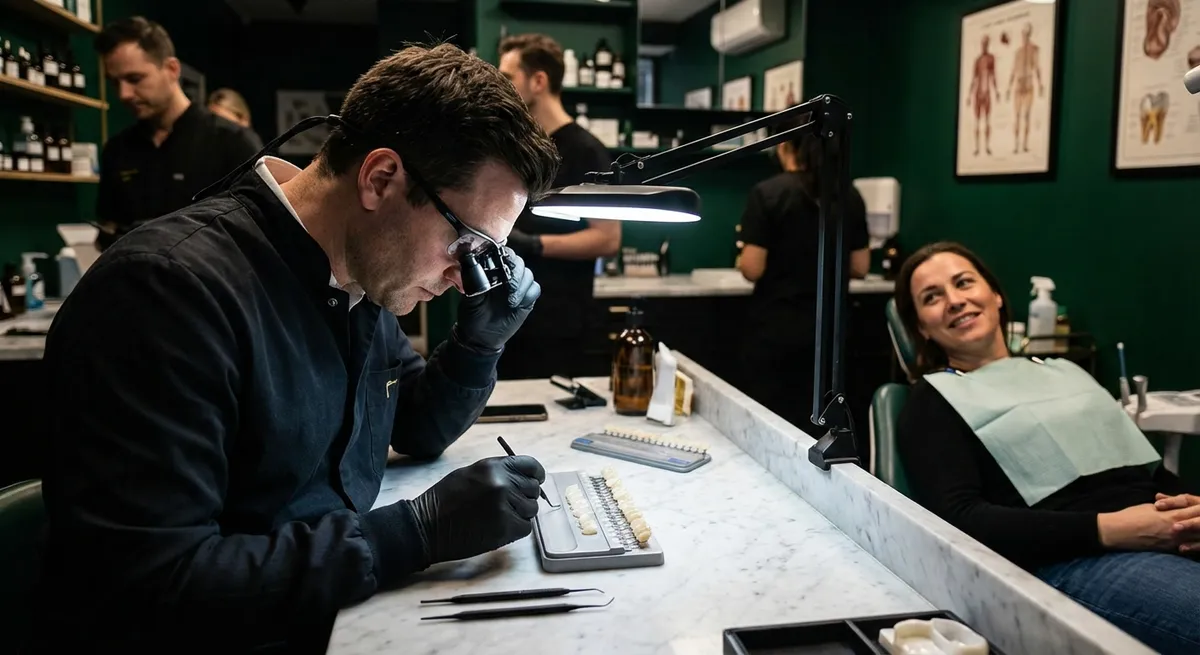
Shade selection is no longer a single number on a chart. At the upper echelon, color is mapped tooth by tooth, zone by zone, so the smile appears naturally dimensional rather than monochromatic and artificial.
A refined color strategy involves:
- Gradient brightness: Slightly brighter central incisors that gradually soften toward canines and premolars, mirroring natural light distribution.
- Layered translucency: The edges of the front teeth often contain subtle translucence and opalescent tones. Modern ceramics can emulate this, avoiding the “block white” look.
- Individual characterizations: Tiny, expertly placed tints or halo effects can echo the personality of natural enamel—without reproducing flaws.
Skin tone, eye color, and even wardrobe preferences are taken into account. Someone who lives in sharp tailoring and jewel tones may choose a cooler, high-luminance white; someone whose style is more understated and tonal might opt for a slightly warmer, softer hue that feels quietly elevated, rather than overtly bright.
The most successful makeovers are not the “whitest,” but the ones whose color language feels innately congruent with the wearer.
4. The Role of Function: How Bite Design Protects Aesthetics Long-Term
An elegant smile is meaningless if it fractures, chips, or causes jaw discomfort a few years later. A premium result is as functional as it is beautiful, with the bite (occlusion) carefully engineered to support the aesthetics long term.
Your dentist may evaluate how your teeth contact in multiple positions—at rest, during chewing, and when you slide your jaw side-to-side or forward. Microscopic misalignments can lead to micro-fractures in porcelain or accelerate wear on natural teeth. In some cases, orthodontic refinement or bite adjustments are quietly integrated into the treatment plan before veneers or restorations are placed.
Designing the smile with function in mind also includes:
- Controlling length and thickness: Front teeth that are slightly too long or too bulky might look perfect in a digital mock-up, but can click against lower teeth or strain the jaw.
- Distributing forces: Strategically shaping canines and premolars helps guide the bite so that no single tooth absorbs disproportionate pressure.
- Biologic compatibility: Matching the contour of restorations to the natural gum architecture supports gum health, preventing inflammation that could undermine the result.
The most sophisticated smile designs often “disappear” into the patient’s everyday life—comfortable, quiet, and stable—precisely because their functional engineering is as meticulous as their cosmetic artistry.
5. The Trial Smile and Digital Rehearsal: Experiencing the Outcome Before You Commit
In high-end smile design, your final result is rarely left to imagination; it is rehearsed. Modern protocols often include a “trial smile”—a meticulously crafted, temporary version of your proposed design that you can wear, evaluate, and refine.
Using digital smile design software and 3D printing, your dentist and lab team can prototype the new shapes and lengths directly over your existing teeth using provisional materials. This allows you to:
- See the proposed smile in your own face, from every angle, instead of relying solely on 2D simulations.
- Test how it feels when you speak, laugh, and eat.
- Capture photos and video in natural lighting to judge how the smile performs in real life.
Any feedback—teeth slightly too long, a contour that feels sharp to the tongue, or a subtle desire for softer corners—can be incorporated before the final ceramics are fabricated. This rehearsal period transforms you from a passive recipient into an active curator of your own outcome.
For patients seeking a result that truly aligns with their self-image, this phase is invaluable: it is where fantasy and reality are reconciled into a design you can confidently own.
Conclusion
A cultivated smile is not the product of a single decision; it is the sum of countless, carefully orchestrated nuances. From the way each tooth participates in your facial architecture, to the micro-texture that catches studio light, to the color map that harmonizes with your complexion, sophisticated smile design is more choreography than quick fix.
For those contemplating a dental makeover, the real luxury lies not only in premium materials or technology, but in the level of thought, precision, and personalization behind every design choice. When aesthetics, function, and individuality are given equal weight, the result is more than a beautiful smile—it is an enduring extension of your identity.
Sources
- American Academy of Cosmetic Dentistry – What Is Cosmetic Dentistry? - Overview of cosmetic dentistry principles and considerations in modern smile design
- Columbia University College of Dental Medicine – Smile Design Concepts - Discussion of how facial features and proportions inform contemporary smile design
- Journal of Prosthodontic Research – Influence of Surface Texture on Appearance of Dental Ceramics - Research on how micro-texture and surface finish affect the esthetics of ceramic restorations
- National Institutes of Health (NIH) – Occlusion and Oral Health - Explanation of how bite (occlusion) impacts long-term dental health and restoration stability
- Harvard School of Dental Medicine – Digital Dentistry Advances - Insights into digital workflows, 3D printing, and their role in planning and prototyping dental treatments
Key Takeaway
The most important thing to remember from this article is that this information can change how you think about Smile Design.