A beautifully designed smile no longer announces itself with obvious veneers or exaggerated whiteness. Today’s most compelling smiles feel quietly intentional—curated with the same care as a bespoke wardrobe or a commissioned artwork. For those considering a dental makeover, true luxury lies not in conspicuous change, but in exquisite calibration: proportion, translucency, and harmony with the face as it naturally moves through the day.
This is where contemporary smile design distinguishes itself—not as a cosmetic add-on, but as a disciplined, almost architectural process. Below are five exclusive, under-discussed insights that discerning patients increasingly expect from top-tier cosmetic dentistry: the kind of refinements that separate a merely “nice” smile from one that feels inevitably yours.
Beyond White: Designing a Personal Shade Signature
In refined smile design, teeth are no longer selected from a stock shade tab labeled “Hollywood White.” Instead, your dentist is effectively composing a tonal palette—one that respects your skin undertone, lip color, iris hue, and even the fabrics you naturally gravitate toward.
A highly considered smile rarely uses a single uniform shade across every tooth. Instead, advanced ceramic work and modern composite layering recreate the subtle gradient of natural enamel: slightly deeper chroma near the gumline, increased translucency at the edges, and restrained brightness that looks luminous in daylight and under flash photography alike. The goal is a “signature shade” that is unmistakably clean and elevated, but never flat or artificial.
Patients with deeper skin tones, for instance, often look most radiant in carefully warmed shades that avoid the blueish cast of ultra-bright bleached tones. Those with fair, cool complexions may suit a more desaturated, porcelain-like whiteness—tempered by micro-translucency to avoid the “chalky” look. In premium smile design, shade selection is not “How white can we go?” but “Which exact temperature, translucency, and brightness create the most expensive-looking version of you?”
The Line of Power: Reading the Smile Through the Eyes, Not the Teeth
Most people assume the smile should be planned tooth-first: length, width, alignment. High-level smile designers begin elsewhere—often with the eyes. Your eyes and smile create a visual axis that either energizes the face or diffuses it. The most compelling smiles are aligned to this “line of power.”
This means your clinician is assessing how your pupils, the corners of your eyes, and your brows relate to your lip line when you speak, laugh, or rest. If the maxillary (upper) teeth appear too low in relation to the eyes, the face can look fatigued or heavy. If they sit too high, the smile can seem strained or juvenile. By calibrating tooth length and incisal edge position to echo the natural lift of your eyes, your smile reads as more awake, more engaged—even in still photographs.
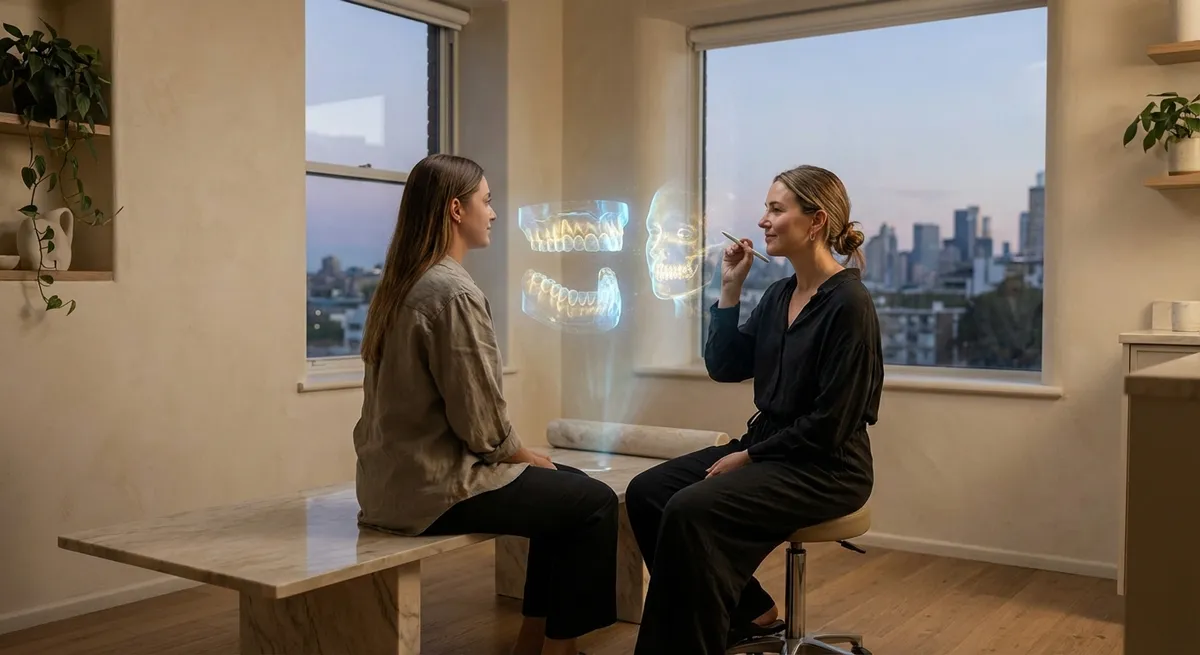
Elite practitioners will take photos and videos from multiple angles—full-face, three-quarter, close-up—as you pronounce different sounds. This allows them to design not just for the static “smile pose,” but for the way your dental aesthetics support your expressions, eye contact, and conversational presence. The result is a smile that seems to draw the gaze upward and inward, toward you—not merely toward your teeth.
Texture, Micro-Detail, and the Luxury of “Uncopyable” Teeth
At the highest level of smile design, perfection is no longer about flawless sameness. Instead, it is about orchestrated irregularity—micro-variations so subtle that others cannot quite identify why your teeth look so convincingly natural and expensive.
Master ceramists play with:
- Surface texture: Gentle vertical striations, soft perikymata, and a satin—not glass—finish that mimics youthful enamel.
- Micro-asymmetry: A whisper of difference between the left and right central incisors, or slightly varied embrasures (the tiny spaces between teeth) that prevent the “piano key” effect.
- Edge characterization: Understated translucency at the biting edge, with minimal “opalescent” halo to keep the smile sophisticated, not theatrical.
- Luster mapping: More gloss in high-light areas, slightly more matte zones near the gumline, so the teeth interact with light like a natural structure, not a uniform ceramic tile.
These details are not simply aesthetic flourishes; they are what make your restorations uniquely yours. Under high-definition cameras and social media filters that reveal every contour, this level of micro-detailing is what separates high-end cosmetic work from mass-market veneers. In effect, you’re not just receiving new teeth; you’re commissioning original artwork for your face.
Lip Architecture: The Quiet Director of an Elegant Smile
Many patients focus solely on the teeth, but the true “frame” of a luxurious smile is the lip architecture—their volume, mobility, and natural curvature. Exceptional smile design considers whether your lips will support or undermine your investment.
Your dentist may study how your lips behave when you recite certain sounds (“F,” “V,” “S,” “E”), when you smile spontaneously, and when your face is at rest. If your upper lip covers too much of the teeth, even perfectly designed veneers can disappear in everyday conversation. Conversely, if a high smile line reveals both gum and tooth extensively, the solution may involve subtle gum contouring or soft-tissue management, rather than simply making the teeth longer.
Collaboration between your cosmetic dentist and, where appropriate, a skilled injector can be transformative—when handled with restraint. The goal is not an augmented “lip look,” but lips that softly support the new smile: enough volume to frame the incisors, enough flexibility to maintain natural expression, and enough structure to prevent lipstick bleeding over new ceramic edges.
In premium treatment planning, your lips are not an afterthought; they are the director that determines how, when, and how much of your smile the world actually sees.
Longevity as a Design Principle, Not an Aftercare Obligation
In many cosmetic makeovers, durability is relegated to the “care instructions” portion of the conversation. In elevated smile design, longevity is engineered from the blueprint stage. The aim is not simply to achieve a beautiful result, but to ensure that beauty remains stable, low-maintenance, and structurally protected over years—not months.
This begins with a nuanced assessment of your bite (occlusion), jaw joint health, and parafunctional habits such as bruxism (clenching or grinding). A veneer that looks immaculate on day one but is placed in a poorly managed bite can chip, crack, or debond in ways that quickly erode both aesthetics and trust. For this reason, refined clinicians often:
- Use digital bite analysis or articulators to balance forces across your new restorations.
- Incorporate minimal, highly strategic tooth reduction to preserve natural enamel—the best bonding surface.
- Recommend custom night guards when appropriate, designed to protect not just the ceramics but the joints and muscles that govern them.
- Choose materials (different porcelains, hybrids, or advanced composites) based on your specific bite dynamics, not simply on a generic “strongest” option.
The result is a smile that behaves as well as it photographs: less prone to sudden failures, less sensitive to small lifestyle changes, and more compatible with an active, high-performance life. In this way, durability stops being a disclaimer and becomes an intrinsic part of the luxury—quietly supporting the aesthetics from beneath the surface.
Conclusion
A sophisticated smile makeover is no longer defined by how dramatically it transforms you, but by how seamlessly it seems to belong to you. The most refined outcomes are not the brightest or the most “perfect,” but the most thoughtfully curated—shade as signature, teeth aligned to your eyes, micro-detailing as a mark of authenticity, lip architecture as an elegant frame, and longevity built into the very design.
For those seeking truly elevated smile design, the conversation should go far beyond “before and after” photographs. Ask instead about texture, translucency, dynamic expression, and bite engineering. The answers will reveal whether you are purchasing cosmetic improvement—or commissioning a long-lasting, luminescent refinement of your entire face.
Sources
- [American Academy of Cosmetic Dentistry (AACD) – About Cosmetic Dentistry](https://aacd.com/about) – Overview of cosmetic dentistry principles, including smile design and aesthetic considerations.
- [Mayo Clinic – Veneers: What to Expect](https://www.mayoclinic.org/tests-procedures/dental-veneer/about/pac-20384980) – Explains veneer materials, procedure steps, and durability considerations relevant to high-end smile makeovers.
- [Cleveland Clinic – Dental Veneers](https://my.clevelandclinic.org/health/treatments/24869-dental-veneers) – Details indications, risks, and longevity of veneers, supporting discussion of design and maintenance.
- [Journal of Esthetic and Restorative Dentistry – The Role of the Smile Line in Esthetic Treatment Planning](https://onlinelibrary.wiley.com/doi/10.1111/jerd.12111) – Research-based insight into how lip position, smile line, and tooth display influence esthetic outcomes.
- [Harvard School of Dental Medicine – Occlusion and Oral Health Overview](https://hsdm.harvard.edu/oral-health-topics) – Discusses occlusion and bite forces, relevant to designing long-lasting, functional smile makeovers.
Key Takeaway
The most important thing to remember from this article is that this information can change how you think about Smile Design.