A truly beautiful smile no longer announces itself with obvious veneers or overly bright enamel. The most coveted smile today is understated, carefully calibrated, and almost impossible to “spot” as cosmetic work. It feels native to your face, aligned with your personality, and executed with the same attention to detail you might expect from haute couture tailoring rather than a standard dental appointment.
Smile design at a premium level is less about chasing perfection and more about orchestrating harmony—between teeth, lips, skin tone, facial structure, and even how you move and speak. Below are five exclusive, often overlooked dimensions of modern smile design that discerning patients quietly prioritize when planning a high-end dental makeover.
1. The “Signature Moment”: Designing How Your Smile Enters a Room
For many patients, the most impactful part of a smile is not a still photograph but a fleeting social moment: the half‑smile when you’re introduced, the polite smile in a boardroom, the spontaneous laugh among friends. Elite smile design now focuses on this “signature moment” as much as the final before‑and‑after photos.
A skilled cosmetic dentist studies how your smile appears across a range of expressions: neutral, conversational, amused, and full laughter. They may record short video sequences instead of relying solely on static images. The goal is to create a smile that reveals itself gradually and gracefully, without “snapping” from serious to exaggeratedly bright.
This subtlety influences the amount of tooth structure that shows when your lips are at rest, how much gum appears at a light smile versus a full grin, and how the incisal edges (the biting edges of the front teeth) follow your lower lip line in motion. The result is a smile that feels alive and natural—never fixed, frozen, or overly “done.”
2. Micro‑Characterization: Elegant Imperfections as a Design Choice
At the highest level of cosmetic dentistry, imperceptible irregularities are no accident. Slight variation in tooth length, tiny textural ridges on the enamel, or a delicately softened corner can be intentionally preserved—or even introduced—to avoid the “template veneer” look.
Rather than cloning a uniform, Hollywood-standard set of teeth, a premium clinician will examine your existing dental “signature”: the individual nuances that already suit your face. They then decide which of these characteristics to retain, refine, or replace.
Micro‑characterization may include:
- Extremely subtle asymmetry between left and right incisors
- Gentle surface texture to mimic natural enamel rather than glassy perfection
- Carefully placed translucency near the edges of teeth
- Soft rather than razor‑sharp embrasures (the spaces between teeth)
These elements are often visible only under close inspection, but they give an expensive smile its quiet authenticity. You look like the best version of yourself—not like someone who ordered a new set of teeth from a catalog.
3. Facial Styling, Not Just Tooth Styling
Conventional cosmetic dentistry often treats teeth in isolation; advanced smile design regards them as one component in a larger composition that includes facial proportions, lip shape, and even the way you dress and present yourself professionally.
A sophisticated planning process might consider:
- Facial thirds and fifths: Whether the height and width of your new smile respect your facial architecture
- Lip support and volume: How tooth position and thickness of restorations subtly support the lips, reducing or accentuating fine lines around the mouth
- Profile and bite relationship: Whether adjustments to the bite can gently improve jawline definition or reduce a “collapsed” middle third of the face
- Age‑appropriate aesthetics: Ensuring the smile’s brightness, translucency, and shape align with your age, rather than erasing it
Some practices incorporate digital smile design software, photography in multiple planes, and even 3D scans to simulate not just how the teeth will look, but how the overall face will present in different lighting and expressions. This is smile design as facial styling—quietly refining how you occupy space, not merely how your teeth look under a flash.
4. The Lifestyle Fit Test: Will Your Smile Age Gracefully With You?
An elevated smile makeover is not judged only on day one; it’s measured by how gracefully it integrates into your lifestyle over the next decade. The most forward‑thinking cosmetic dentists perform an informal “lifestyle fit test” long before any enamel is touched.
They may ask:
- How often do you drink coffee, tea, red wine, or highly pigmented foods?
- Do you grind or clench your teeth, particularly under stress or at night?
- Is your work heavily on‑camera, public‑facing, or largely private and remote?
- Do you prefer low‑maintenance routines, or are you comfortable with periodic professional touch‑ups and polishing?
These answers influence everything from material selection (porcelain vs. composite, types of ceramics, stain resistance) to the design of your bite and the use of protective night guards. Someone who travels frequently and lives on espresso will require different planning than someone working in a low‑stress, primarily offline environment.
The goal is to build durability and practicality into the design so your smile remains immaculate without constant intervention, aligning with how you actually live rather than an idealized version of your habits.
5. Emotional Calibration: Matching Your Smile to Your Personal Brand
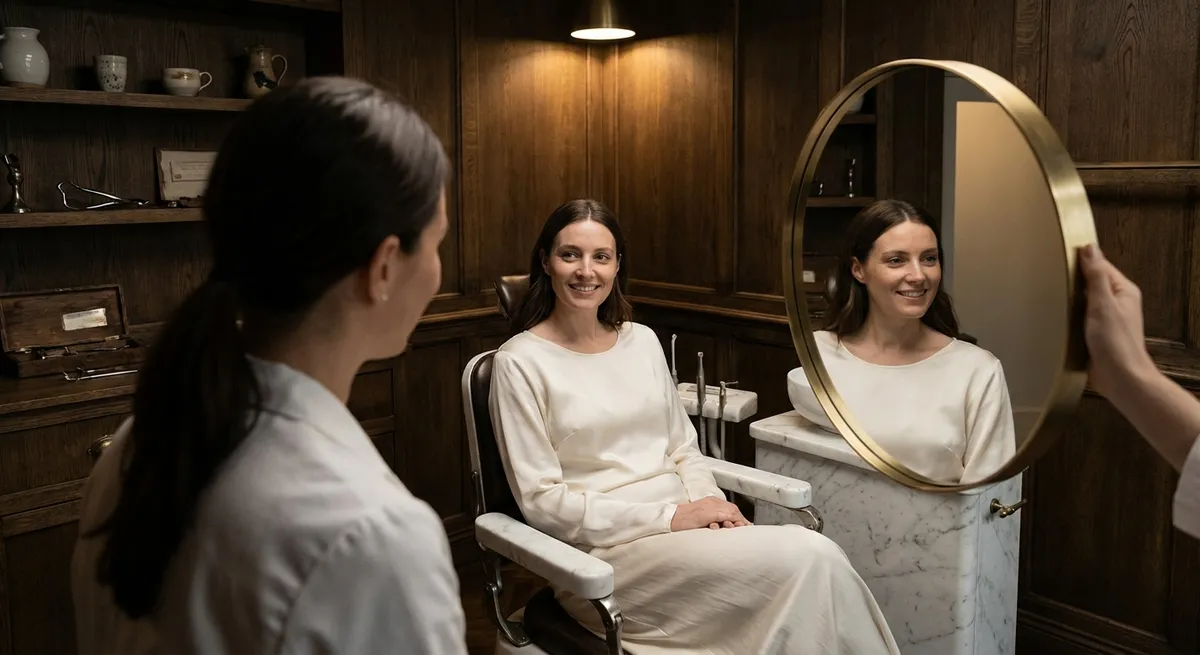
Beyond anatomy and materials, a high-level smile makeover is an exercise in emotional calibration. The best clinicians listen closely to how you describe yourself and how you want to be perceived: authoritative, approachable, youthful, understated, artistic, or classic.
From there, they translate personality into design language:
- More rounded tooth shapes can feel softer, warmer, and more approachable
- Slightly squarer, more defined forms can communicate professionalism and strength
- High‑value (whiter) teeth can read as glamorous or high‑impact, while
- More natural, layered brightness tends to feel refined and discreet
Even minute choices—the curvature of the central incisors, the degree of translucency, the contour of the canines—can subtly shift whether your smile feels playful or composed, bold or restrained.
When done well, this process allows your smile to become an authentic extension of your “personal brand.” People may not know why you appear instantly more centered, confident, or charismatic—but the smile quietly aligns with the story you wish to tell about yourself.
Conclusion
The era of obvious cosmetic dentistry is giving way to something more nuanced: smile design that prioritizes authenticity, motion, and long-term harmony over shock value. The most desirable smiles now are quiet luxuries—flawlessly executed, but never loudly announcing the work behind them.
By seeking a clinician who understands the importance of your signature smile moment, micro‑characterization, facial styling, lifestyle fit, and emotional calibration, you move beyond simple cosmetic enhancement into curated self‑presentation. The result is not just a brighter smile, but a more deliberate, composed way of showing up in the world.
Sources
- American Academy of Cosmetic Dentistry (AACD) – What Is Cosmetic Dentistry? – Overview of cosmetic procedures and aesthetic considerations in modern smile design.
- UCLA School of Dentistry – Esthetic Dentistry – Describes advanced esthetic treatment planning, materials, and techniques used in high-end cosmetic cases.
- Mayo Clinic – Dental Veneers – Explains veneer indications, benefits, risks, and durability considerations relevant to long-term smile planning.
- Columbia University College of Dental Medicine – Occlusion and Bite – Discusses bite relationships and their significance in function and facial balance, essential to comprehensive smile design.
- National Institutes of Health (NIH) – The Psychology of Facial Appearance – Reviews how facial and dental appearance influences social perception and self-image, supporting the concept of emotionally calibrated smile design.
Key Takeaway
The most important thing to remember from this article is that this information can change how you think about Smile Design.