A truly elevated smile makeover is not about whiter teeth alone; it is about orchestrating a quiet harmony between proportion, light, and character. For patients who expect more than a standard “before and after,” modern smile design has evolved into a nuanced discipline—one that observes the face from every angle, listens closely to the patient’s lifestyle, and respects individuality over formulas.
Below, we explore how sophisticated smile design really works today, and share five exclusive insights that discerning patients often discover only once they are already deep into treatment planning.
Beyond “Perfect Teeth”: Designing for Facial Harmony, Not Just the Mouth
High‑level smile design begins outside the mouth. Rather than chasing a generic “Hollywood” ideal, leading clinicians examine how your teeth interact with your facial architecture—cheek volume, lip mobility, nose and chin profile, even the whites of your eyes.
Facial harmony means your teeth should neither dominate your features nor disappear into them. For example, a softly rounded incisor edge might complement fuller lips and a more delicate jawline, while slightly squarer, more defined edges can echo a stronger chin or angular cheekbones. The aim is for your new smile to look inevitable—as if it has always belonged to your face.
This level of design often includes extra‑oral photography, video recordings while speaking and laughing, and digital facial scans. These references allow your dentist and ceramist to map the smile within the full facial frame, not just within the confines of the dental arch. The result is a smile that appears balanced and calm in both still photos and real‑life movement.
The Five Exclusive Insights Behind Truly Elevated Smile Design
The following five insights often remain behind the scenes in a typical dental consultation, yet they profoundly shape the outcome for patients seeking refined, natural‑looking transformations.
1. Micro‑Texture and Gloss Control Signal Authenticity
Natural teeth are not uniformly smooth. They have micro‑texture—fine vertical ridges, subtle undulations, and varying gloss levels—that catch light in a complex way. High‑end ceramic work mimics this with extraordinary precision.
A uniform, mirror‑like surface can look artificial, especially in brighter shades. Premium smile design intentionally softens and varies the surface, so the front teeth reflect light differently at the incisal edge, mid‑body, and cervical area. This nuanced gloss management keeps the teeth from appearing flat on camera or overly reflective in direct light.
For patients who are in front of cameras, presentation rooms, or under studio lighting, this attention to texture ensures the smile remains sophisticated across all environments, rather than suddenly looking too “done” in high‑definition images.
2. Lip Dynamics Are as Critical as Tooth Shape
Teeth do not exist in isolation; they are framed by your lips in constant motion. Advanced smile design therefore studies your “smile envelope”: how wide your lips travel, how high they lift, and how they move when you speak versus when you laugh spontaneously.
A premium designer will often assess:
- The amount of tooth and gum visible at rest
- How much upper and lower teeth show during speech
- Whether your smile line follows the natural curve of your lower lip
- How the corners of your mouth rise—or don’t—when you smile
Subtle adjustments in tooth length and curvature can help visually support the corners of the mouth, making the smile line appear more buoyant and youthful. This is especially powerful for patients who feel they “almost” smile, but never quite reach a expressive, open look. Properly designed incisal edges and buccal corridors can bring that final sense of lift without any change to the lips themselves.
3. “Translucency Zones” Create a Quietly Luxurious Finish
In elevated smile design, the most convincing veneers and crowns incorporate planned translucency, especially near the incisal edge. Natural enamel is partially translucent, with deeper, warmer dentin beneath. Simply replicating the color, without these layers, often produces an opaque, “blocky” look.
Advanced ceramists build in delicate translucency zones at the tips of the teeth, sometimes adding whisper‑soft effects like opalescence or faint internal halo lines—always within the bounds of natural anatomy. These details are rarely visible to the casual observer, but they are perceived subconsciously as authenticity.
Patients who are particularly sensitive to aesthetics often respond strongly to this quality; the smile appears luminous rather than simply bright, much like fine fabrics reflect light differently from synthetics.
4. Functional Precision Protects the Beauty You’ve Invested In
A refined smile that chips, fractures, or feels uncomfortable within months is not truly luxurious. High‑level smile design therefore prioritizes occlusion (your bite) as much as appearance.
Meticulous planning looks at:
- How your upper and lower teeth meet in all jaw movements
- Whether certain teeth are overloaded during chewing or grinding
- How restorative materials and thicknesses will respond to your bite forces
- Any underlying TMJ or muscle tension that could jeopardize longevity
This is particularly critical for patients who clench or grind, or who have had orthodontic relapse. The most elevated treatment plans sometimes include pre‑restorative orthodontics, bite equilibration, or a custom night guard to safeguard the final result. The aesthetic is the visible outcome; the functional engineering is the reason it endures.
5. Your Personal Brand Should Inform Shade, Shape, and Style
For patients whose image plays a role in their profession—executives, creatives, public figures—smile design can be aligned with personal brand as intentionally as a wardrobe or signature fragrance.
This goes beyond choosing “how white” you want your teeth. A patient whose brand leans toward understated, intellectual, and discreet might prefer slightly softer value (brightness) and very natural shapes, avoiding anything overly uniform. Another whose brand is aspirational, high‑gloss, and fashion‑forward may welcome a crisper shade and more precise alignment.
Elevated clinicians often involve questions like:
- In what environments are you most often photographed?
- What message should your smile convey—approachable, authoritative, glamorous, restrained?
- How do you dress for business, for evenings, for casual weekends?
The resulting design choices—shade gradient, edge character, symmetry tolerance—are then integrated so that your new smile feels like an extension of you, not a template from someone else’s aesthetic.
The New Planning Experience: From 2D Mock‑Ups to Immersive Visualization
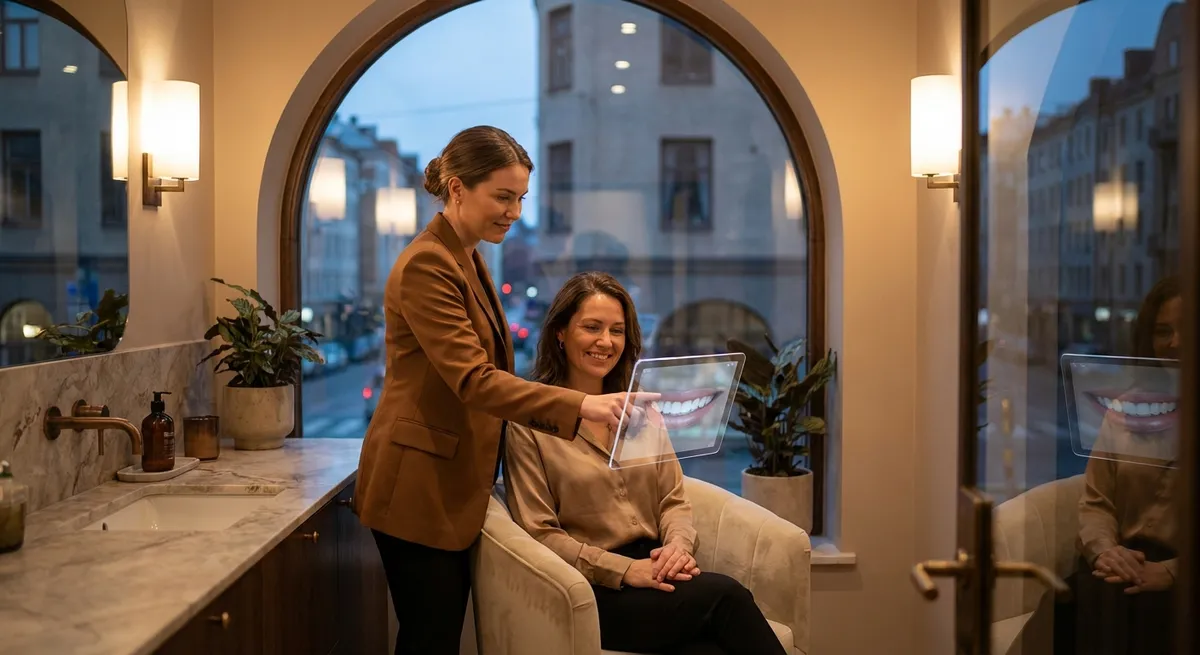
The modern luxury in smile design is not only in the materials, but in the planning experience itself. Patients can now “test‑drive” their future smiles before any irreversible treatment.
Digital smile design software, intraoral scanners, and high‑resolution photography allow your dentist and lab to create precise 3D models of your current dentition and proposed changes. From there, a mock‑up—digital or physical—can be previewed on screen or even placed temporarily over your existing teeth.
This step serves several sophisticated purposes:
- It verifies that the design works aesthetically from every angle—smiling, speaking, and in profile.
- It lets you evaluate whether the new smile matches your personality, not just your wish list.
- It gives the dental team a clear blueprint, minimizing guesswork during the actual procedures.
In more bespoke settings, short videos of you speaking with the mock‑up in place may be captured, so both you and your dentist can evaluate nuances of expression and phonetics. Adjustments can then be made before any permanent ceramics are fabricated, dramatically increasing confidence in the final outcome.
Conclusion
A refined smile makeover is less about spectacle and more about subtle orchestration—of facial lines, dental anatomy, functional balance, and personal identity. The patients who are most satisfied long‑term are those who treat smile design as a collaborative design process, not an off‑the‑shelf procedure.
By understanding how micro‑texture, lip dynamics, translucency, functional precision, and personal brand shape your final result, you can ask better questions, set more precise expectations, and ultimately achieve a smile that feels like an effortless extension of you—quietly elevated, impeccably considered, and built to last.
Sources
- American Dental Association – Esthetic Dentistry Overview - Provides a professional overview of cosmetic and esthetic dentistry concepts and procedures.
- Columbia University College of Dental Medicine – Esthetic Dentistry - Outlines principles of esthetic treatment planning in an academic context.
- National Institutes of Health (NIH) – Digital Smile Design in Multidisciplinary Dentistry - Discusses the use of digital smile design and its role in comprehensive treatment planning.
- Mayo Clinic – Veneers - Explains veneers, indications, and considerations relevant to high‑end smile makeovers.
- University of Minnesota School of Dentistry – Occlusion and Function - Describes the importance of occlusion and functional analysis in protecting restorative work.
Key Takeaway
The most important thing to remember from this article is that this information can change how you think about Smile Design.