In an era where taste is measured in nuance rather than noise, the most compelling smiles are not the brightest in the room—but the most effortlessly aligned with the person behind them. True smile design is no longer about simply “fixing teeth.” It is an intimate, highly tailored process that considers facial architecture, lifestyle, personality, and even how you move through light and camera. For those seeking a dental makeover that feels less like a procedure and more like a private commission, understanding the layers behind modern smile design is essential.
Below are five exclusive insights that sophisticated patients now quietly expect—and discerning clinicians carefully orchestrate—when curating a high-level smile transformation.
1. The Smile as a Moving Portrait, Not a Static Pose
Traditional cosmetic dentistry often evaluates your teeth in a still photograph or a single mirror view. Elevated smile design instead treats your face as a dynamic canvas. How you speak, laugh, and turn your head under different light sources are all part of the design brief.
Clinicians increasingly rely on video analysis, 3D scans, and digital simulations to observe micro-movements: the way your upper lip lifts on one side, how your cheeks compress during a full laugh, how your lower lip traces the edges of your upper teeth when you speak. These motion cues inform tooth length, edge contours, and incisal translucency so that your final result feels natural in motion—not just “perfect” when you freeze and smile on command.
This approach is especially crucial for individuals in front of cameras, on stages, or in executive environments where candid expressions are constantly observed. The real luxury is not a flawless still image, but a smile that remains quietly impeccable in every unguarded moment.
2. Micro-Proportions: Why One Millimeter Can Redefine Your Entire Expression
The most sophisticated smile designs rarely announce themselves. Instead, they rely on micro-adjustments that subtly transform the entire face. A single millimeter in tooth length, a gentle rotation to soften a shadow, or a barely perceptible change in the gumline can make the difference between a smile that feels “done” and one that simply looks like you at your absolute best.
Advanced smile designers look beyond the classic “golden ratio” and apply more nuanced facial mapping:
- The relationship between tooth length and upper lip support
- The width of the central incisors relative to your pupils and nasal base
- The way side teeth blend into facial contours rather than dominate them
Attention to these refined metrics means that the makeover doesn’t compete with your features; it choreographs them. Patients who value discretion often favor this approach because the result is elegant, believable, and resistant to ever-changing aesthetic trends.
3. Texture, Translucency, and the Art of “Undetectable” Restorations
High-end smile design has quietly moved away from overly bright, ultra-flat veneers. The new standard of excellence is indistinguishability: restorations that even dental professionals must look closely to detect.
To achieve this, designers focus on three underappreciated factors:
- Surface Texture: Natural teeth are not glass-smooth; they exhibit subtle grooves, ridges, and micro-textures that diffuse light. Artfully sculpted texture on porcelain or composite allows restorations to “read” as real under daylight, flash photography, or studio lighting.
- Translucency and Layering: Premium ceramics are layered, not simply tinted. Slight opalescence near the incisal edges and warmer, denser tones near the gumline create the same depth you see in natural enamel and dentin.
- Calibrated Shade Selection: Rather than choosing the whitest shade available, sophisticated clinicians often select a carefully moderated hue—sometimes even incorporating slight characterizations or soft gradations—to harmonize with the sclera of the eyes, the skin’s undertones, and age-appropriate aesthetics.
The resulting smile does not broadcast “cosmetic work.” It simply looks fresh, luminous, and endlessly photographable without appearing artificial.
4. Lifestyle-Coded Design: Tailoring Smiles to How You Actually Live
A refined smile makeover is no longer conceived in a vacuum; it’s calibrated to your reality. High-stakes professionals, frequent travelers, public figures, and epicureans all ask different things of their smiles.
An elevated design process will take into account:
- Professional Context: A trial lawyer, venture capitalist, or executive may prefer a more grounded, less conspicuously “cosmetic” look—aligned, balanced, but restrained in brightness and contour to signal authority and authenticity.
- Diet and Habits: Coffee, red wine, matcha, or fine cigars all influence material selection and maintenance planning. Ceramics with superior stain resistance or strategically placed composite may be recommended depending on your rituals.
- Travel and Schedule: Those with demanding calendars benefit from treatment plans that minimize chair time, use digital workflows for speed and precision, and build in maintenance that can be handled efficiently during short visits.
- Aging Gracefully: The most refined smile designs anticipate how your lips, cheeks, and facial volume will evolve over the next decade. Designers may opt for slightly softer incisal edges, thoughtfully chosen shades, and tooth positions that will remain flattering as you age—rather than chasing a temporarily fashionable “look.”
The result is a smile that aligns not only with your face, but with your calendar, your pursuits, and your long-term vision of self.
5. The Luxury of the “Prototype Smile” Before You Commit
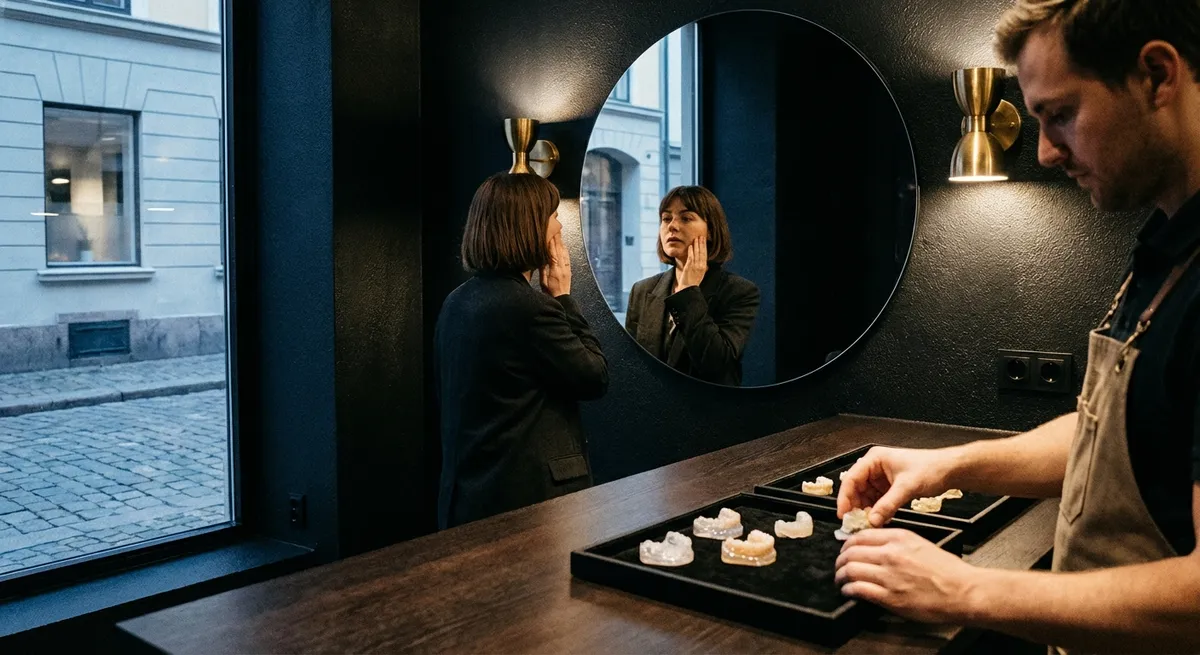
In couture fashion, a muslin toile is created before the final garment. In elevated smile design, the equivalent is a highly sophisticated “prototype smile”—often called a diagnostic mock-up or trial smile—crafted so you can experience the transformation before anything permanent is done.
This stage can be remarkably revealing. Through bonded mock-ups, 3D-printed temporaries, or digital overlays:
- You experience how your new teeth feel when you speak or bite
- You see how the design behaves in different lighting, from boardrooms to black-tie events
- You can give nuanced feedback—perhaps asking for slightly softer incisal angles, a touch more visible tooth when relaxed, or a gentler curve to the smile line
For discerning patients, this prototype phase is non-negotiable. It transforms the process from passive acceptance into collaboration. The final smile is not simply something that is “done to you,” but something you have quietly co-authored—an understated luxury that ensures you never feel surprised by the end result.
Conclusion
Truly elevated smile design is not about chasing perfection; it is about orchestrating coherence—between your features, your lifestyle, your age, and the image you choose to project. The most luxurious makeovers are not instantly obvious; they are felt in how comfortably you inhabit your face, how naturally you move on and off camera, and how rarely you even think about your teeth once the work is complete.
For those considering a high-level transformation, seek a clinician who designs not only with measurements and materials, but with a curator’s eye and a quiet respect for who you already are. The finest smile is not a new identity—it is the most refined version of the one you’ve always carried.
Sources
- American Academy of Cosmetic Dentistry – Smile Design Principles – Overview of modern smile design concepts and aesthetic considerations used by cosmetic dentists
- Mayo Clinic – Dental Veneers Overview – Explains veneer materials, indications, and what patients can expect from cosmetic restorations
- Journal of Esthetic and Restorative Dentistry – The Golden Proportion Revisited – Peer-reviewed research discussing proportions and esthetic principles in smile design
- UCLA School of Dentistry – Digital Dentistry and 3D Imaging – Details how digital workflows, imaging, and 3D technologies enhance planning and execution of esthetic treatments
- Columbia University College of Dental Medicine – Esthetic Dentistry Overview – Describes advanced cosmetic and esthetic dental procedures and their role in comprehensive smile makeovers
Key Takeaway
The most important thing to remember from this article is that this information can change how you think about Smile Design.