A truly unforgettable smile is rarely an accident. It is the product of disciplined planning, aesthetic sensitivity, and a quiet commitment to detail that most observers will never fully see—but will instantly feel. Modern smile design is no longer about “perfect teeth” in the abstract; it is about creating a facial signature that looks inevitable, as if it could never have been any other way. For those considering a high-level dental makeover, understanding how that refinement is orchestrated is the difference between a generic result and a deeply personal transformation.
Smile Design as Facial Architecture, Not Just “Nice Teeth”
Advanced smile design begins well beyond the dental arch. Your dentist or prosthodontist should study how your teeth live within your entire face: lip dynamics, midline symmetry, nasolabial contours, and even the way your eyes narrow when you laugh.
Digital Smile Design (DSD) and similar systems allow clinicians to overlay proposed changes on high-resolution photos and videos of your face, in motion, not just at rest. This turns your smile into a piece of facial architecture that respects proportions, angles, and lines unique to you.
Instead of chasing generic “Hollywood white,” the goal becomes visual harmony: how incisor length interacts with lip fullness, how much tooth should be revealed at rest versus in full smile, and how subtle edge irregularities keep the result from looking artificial. When done properly, others may notice that you look remarkably refreshed without being able to identify that dentistry is responsible.
Insight 1: The Importance of “Resting Tooth Display”
One of the most underestimated elements in smile design is how much tooth you show when your face is at rest—before you speak, smile, or pose for a camera. This “resting tooth display” quietly communicates youthfulness, vitality, and ease.
As we age, the upper lip tends to descend and teeth wear down, reducing visible tooth structure when the mouth is relaxed. In advanced smile makeovers, clinicians often design incisor length to restore an elegant amount of visible enamel—typically 1–3 mm—while the lips are at rest, adjusted to your facial proportions and age.
Too little tooth display can make the face appear tired or stern; too much can look strained or artificial. The ideal balance is subtle: enough visibility to suggest brightness and energy, but not so much that the teeth dominate the lower third of the face. When you evaluate potential providers, ask how they assess and plan for resting tooth display; it is a small detail with an outsized impact.
Insight 2: Texture and Micro-Details That Avoid the “Denture Look”
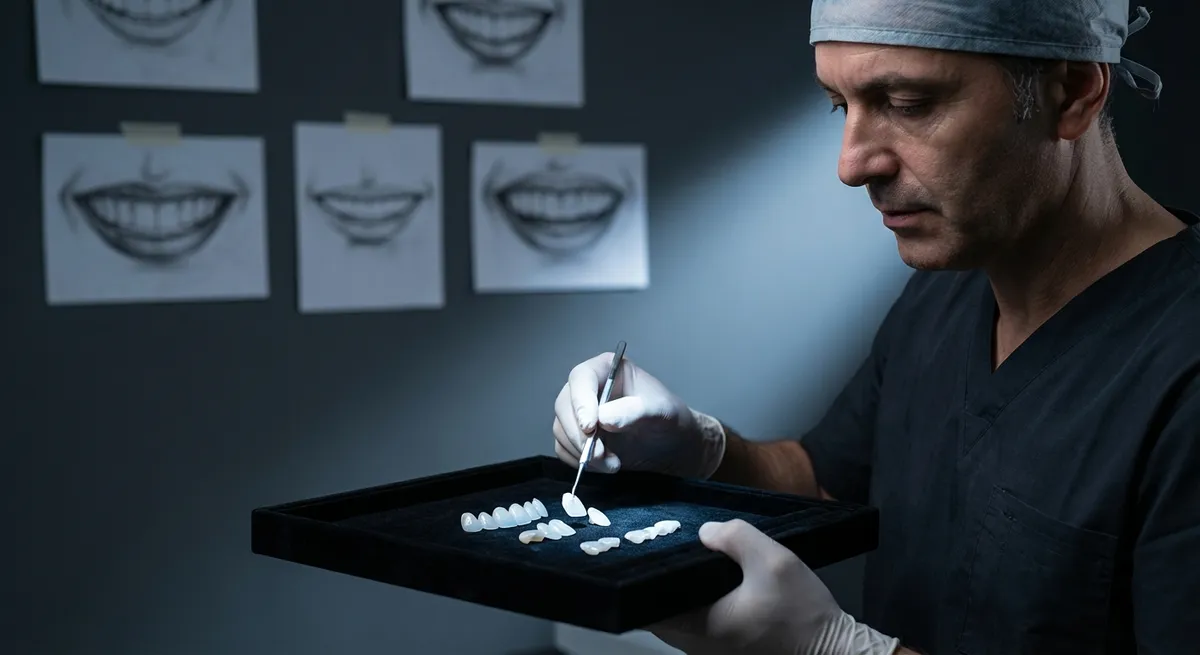
At elevated levels of cosmetic dentistry, the focus shifts from simply getting the shape “right” to capturing the micro-details that make teeth look alive. Natural teeth are not perfectly flat, uniformly shiny slabs. They have gentle texture, tiny vertical ridges, faint halo effects along the edges, and a delicate interplay of translucency and opacity.
High-end ceramists and cosmetic dentists design these micro-characteristics intentionally:
- Surface texture: Slightly varied surface texture breaks up light in a way that feels natural and youthful, as opposed to the overly glossy, plastic-like sheen of mass-produced restorations.
- Translucency gradients: The incisal edges (biting edges) often appear more translucent, while the area near the gumline is more opaque—mimicking real enamel and dentin.
- Subtle asymmetry: Very slight variations between the left and right sides—while maintaining symmetry in overall width and length—can prevent the “cloned tooth” appearance.
These nuances are seldom discussed in consumer-facing materials, yet they are often what separate a high-end case from an average one. When reviewing before-and-after photographs, look closely at surface detail; if the teeth appear uniformly flat or eerily identical, the work may lack the refined craftsmanship you’re seeking.
Insight 3: The Smile in Motion—Planning Beyond Static Photographs
Many smile consultations rely heavily on static photographs. But in real life, your teeth are rarely still. They interact with speech, laughter, subtle smirks, and unguarded moments. The most sophisticated practitioners now evaluate smiles through dynamic video, not just before-and-after images.
This “smile in motion” approach reveals:
- How your upper and lower lips frame the teeth during conversation
- Whether gum tissue shows more than intended when you laugh naturally
- If restorations will flash too brightly under certain lighting or angles
- How the bite supports comfortable, fluid jaw movement when talking and chewing
A design that looks immaculate in a perfectly posed photo may appear overly dominant or stiff when you’re animated. Asking your clinician whether they use video analysis—or at least record you speaking and laughing during the planning phase—is an excellent way to gauge how deeply they consider real-world aesthetics, not just studio-ready images.
Insight 4: Color That Respects Skin Tone, Age, and Lifestyle
Tooth shade is often treated as a simple scale from “off-white” to “maximum white,” but refined smile design approaches color as a nuanced spectrum. The right shade should feel integrated with your complexion, eye color, and even your wardrobe and professional environment.
Factors an advanced practitioner will consider:
- Skin tone: Cooler, brighter shades may complement fair or cool-toned skin, while warmer neutral tones often flatter deeper or warmer complexions.
- Age-appropriate brightness: A tastefully bright smile can look exquisite; an overly stark shade can appear harsh, especially with mature skin. Subtle warmth and depth often create a more believable, “quietly expensive” effect.
- Lifestyle and maintenance: If you frequently consume coffee, tea, red wine, or richly colored foods, a hyper-bright shade may require more intensive maintenance to keep the contrast from becoming apparent over time.
The most luxurious smiles look luminous, not simply white. They borrow from the visual language of fine porcelain, silk, and natural light—balanced, layered, and never flat. During your consultation, ask to see multiple shade options in your mouth under different kinds of lighting (daylight, indoor, and flash) to ensure the color holds up gracefully in every setting.
Insight 5: Designing for Long-Term Comfort, Not Just Immediate Beauty
A truly elevated smile makeover respects not only appearance but also how your teeth, muscles, and joints will feel years from now. Beautiful veneers that disrupt your bite or strain your jaw can lead to headaches, chipped restorations, or a sense that your teeth “don’t quite fit.”
High-caliber smile design incorporates:
- Occlusal analysis: Careful assessment of how your upper and lower teeth meet and slide across each other, often with bite scans or articulators that simulate jaw movement.
- Muscle comfort: Ensuring the new tooth positions and lengths do not force the jaw into a tense posture, especially in patients who clench or grind.
- Material choice: Selecting ceramics and bonding techniques suited to your bite forces and habits, not just to aesthetics.
- Protective strategies: Night guards, follow-up adjustments, and periodic checks to ensure that the restorations and surrounding structures remain in harmony.
This integration of function and form is what allows a high-end smile makeover to feel as good as it looks—effortless to live with, not just impressive in photographs.
How to Evaluate Whether a Dentist Truly Practices Advanced Smile Design
For discerning patients, the challenge is not only understanding these concepts but identifying a provider who works at this level of refinement. During consultations, consider asking:
- How do you assess my smile relative to my entire face, not just my teeth?
- Do you use digital smile design, video analysis, or mock-ups to preview results?
- How do you decide on tooth length, shape, and resting display for someone with my facial features?
- How do you ensure my bite and jaw will be comfortable after treatment?
- Can I see close-up photos that show surface texture, translucency, and natural variation?
The answers should demonstrate not only technical knowledge but an aesthetic philosophy that aligns with your own expectations: personalized, meticulous, and unhurried.
Conclusion
Sophisticated smile design is less about dramatic transformation and more about intentional evolution. When planned with precision, your smile becomes an extension of your individuality—an understated yet unmistakable expression of who you are. By looking beyond surface-level promises of “perfect teeth” and instead seeking practitioners who understand architecture, motion, texture, color, and comfort, you position yourself for a result that feels both elevated and deeply authentic.
In the end, the most luxurious outcome is not the smile that demands attention, but the one that quietly, consistently enhances every moment you live in it.
Sources
- American Academy of Cosmetic Dentistry – Cosmetic Dentistry Procedures – Overview of cosmetic treatments and principles used in advanced smile design
- Harvard School of Dental Medicine – Esthetic Dentistry Overview – Academic perspective on aesthetic and functional considerations in modern dentistry
- Journal of Prosthetic Dentistry – Esthetic and Functional Parameters in Smile Design – Research-based discussion of facial and dental factors in smile design
- Mayo Clinic – Dental Veneers – Clinical information on veneers, indications, and long-term considerations
- National Institutes of Health (NIH) – Digital Smile Design Case Report – Case-based insight into how digital tools enhance planning and aesthetic outcomes
Key Takeaway
The most important thing to remember from this article is that this information can change how you think about Smile Design.