A truly exceptional smile no longer announces itself with obvious veneers or over-brightened enamel. Today’s most desirable results are curated—subtle, intentional, and harmonized with the individual rather than imposed upon them. Cosmetic dentistry, at its highest level, behaves more like couture than commodity: meticulously tailored, collaborative, and quietly transformative.
For those considering a dental makeover, understanding what actually separates an ordinary result from an exquisite one is essential. Beyond before-and-after photos and shade charts lies a level of planning, precision, and personalization that is rarely discussed publicly. Below are five exclusive insights that discerning patients—especially those investing in premium smile design—consistently appreciate once they step behind the scenes.
1. Your Smile Has a “Design Language” — and the Best Dentists Decode It
Every face communicates a visual vocabulary: the angle of the jawline, the proportion of the lips, the curvature of the upper lip line, even the way the eyes narrow when you laugh. High-level cosmetic dentists read this “design language” before they ever reach for a drill or veneer.
Rather than starting from a generic ideal, they analyze facial thirds, lip dynamics, midline symmetry, gum display, and the way your teeth appear in motion—during speech, laughter, and repose. The goal is not to create “perfect” teeth in isolation, but to orchestrate a smile that feels inevitable on your face, as though it always belonged there.
This is where advanced digital smile design and photography enter the picture. High-resolution images, 3D scans, and video of your natural expressions help your dentist map the way light interacts with your enamel and how your lips frame your teeth moment by moment. The resulting plan is less about imposing a template and more about crafting a visual narrative in which your teeth are supporting characters, never the entire story.
2. Elite Results Depend on Collaboration: Dentist, Lab, and Patient as a Design Team
Behind every refined smile makeover is an invisible ensemble: the cosmetic dentist, the master ceramist in the dental lab, and an informed, engaged patient. When this triangle is strong, the final result often surpasses what any one person envisioned at the start.
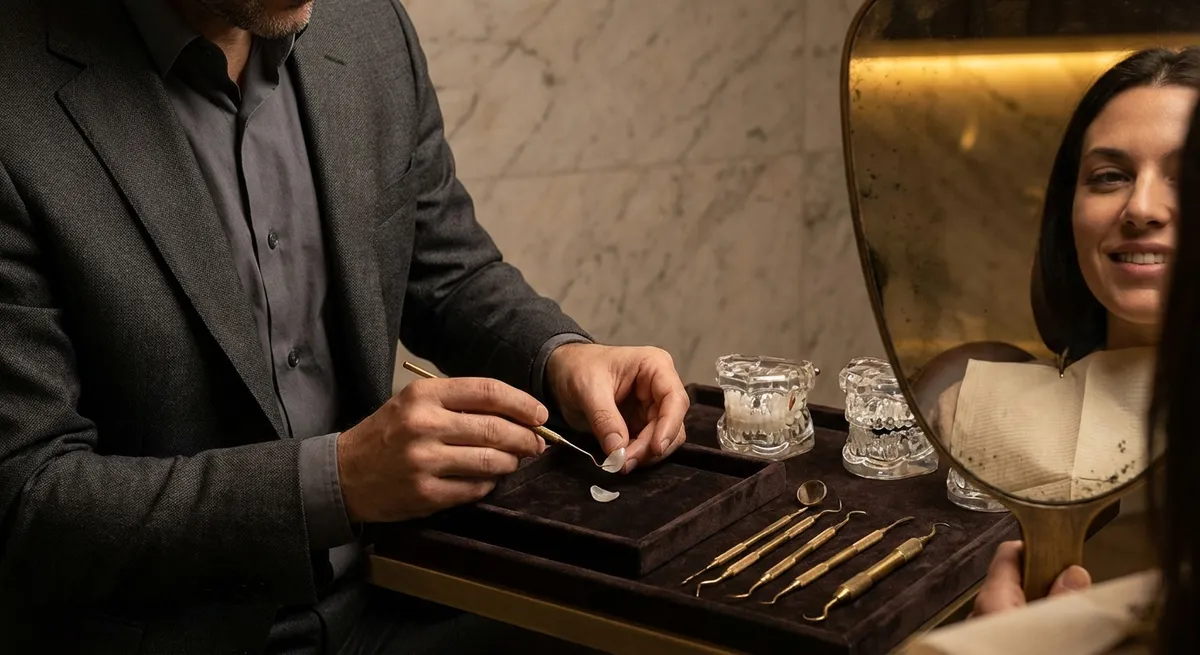
Premium practices frequently work with boutique dental labs that specialize in hand-layered ceramics rather than mass-produced restorations. These ceramists are artisans; they study the translucency of natural enamel, mimic microscopic surface texture, and customize internal characterization so the teeth do not appear flat or artificial under different lighting. Subtle variations—barely perceptible to the untrained eye—distinguish a “nice” result from a truly exceptional one.
Equally important is patient involvement. You are encouraged to discuss not just the shade you think you want, but how you wish your smile to feel: approachable, polished, youthful, authoritative, or quietly understated. The most sophisticated outcomes emerge when you view yourself as a co-designer rather than a passive recipient. Trial smiles, provisional restorations, and staged whitening or orthodontics are all tools that allow you to refine that design in real time before the final ceramics are created.
3. Time Is a Luxury Ingredient: Why Rushing a Makeover Compromises the Outcome
In elite cosmetic dentistry, time is treated as a material resource, as essential as porcelain or composite. While some clinics promise “instant smile makeovers,” truly bespoke work is rarely rushed. Extended consultation, detailed diagnostics, and trial phases exist not as add-ons but as safeguards against regret.
Multiple appointments may be devoted purely to records: photographs, radiographs, digital scans, mounted models, and bite analysis. These are followed by a wax-up or digital mock-up that previews the proposed changes in three dimensions. Even the temporary restorations are deliberately refined; they function as a wearable prototype, allowing your dentist to observe your phonetics, chewing comfort, and gum response before committing to the final design.
This deliberate pacing also allows for strategic sequencing—aligning teeth with clear aligners before veneers, treating any gum disease, addressing clenching or grinding, and achieving a stable bite. Each step reduces the risk of chipping, sensitivity, or premature wear, and helps ensure that your investment ages gracefully rather than dramatically fading in quality after a few years.
4. Enamel Preservation Is the New Gold Standard of Aesthetic Care
The most sophisticated cosmetic dentistry now revolves around restraint: preserving as much healthy tooth structure as possible while still achieving dramatic visual refinement. Modern techniques and materials have made this philosophy more realistic than ever.
Ultra-thin porcelain veneers, enamel-bonded onlays, no-prep or minimal-prep restorations, and strategic orthodontics can often replace the aggressive tooth reduction that was once commonplace. Instead of “filing teeth down,” the dentist uses precision planning to add where enhancement is needed and remove only what is essential for fit, function, and longevity.
This shift is not merely aesthetic—it is protective. Enamel does not regenerate; every millimeter saved today increases your options tomorrow. A future retreatment, bite adjustment, or material upgrade becomes more straightforward when the underlying tooth is strong and intact. For patients, this means that the most elegant smile is also often the most conservative, designed with decades—not just a new photo shoot—in mind.
5. True Luxury Lives in the Details You Don’t Immediately Notice
The most refined cosmetic work rarely calls attention to itself. Instead, it feels “right” in a way that is difficult to articulate. This effect is created by a constellation of quiet details that may not be obvious at first glance—but collectively define a premium result.
Subtle texture is etched into the porcelain to mimic youthful enamel, so the surface doesn’t look overly glossy under flash photography. The incisal edges (the biting edges of front teeth) are carefully varied so they don’t resemble identical piano keys. The internal coloration of each tooth is nuanced—slightly warmer near the gumline, with gentle translucency toward the edges—to avoid a monochromatic, opaque look.
Attention extends beyond the teeth themselves. The way your gums frame the restorations, the symmetry of the smile line against the lower lip, the way your new teeth affect your speech sounds, and how natural they appear in casual, unposed expressions are all carefully evaluated. Patients often report that friends and colleagues notice they look “rested” or “refreshed” without being able to pinpoint why—that ambiguity is the hallmark of meticulously executed cosmetic dentistry.
Conclusion
A modern smile makeover, at its highest level, is less a procedure and more a curated experience. It blends design thinking, clinical precision, technical artistry, and an unwavering respect for natural tooth structure. The most desirable results are not simply bright or straight; they are intentional, durable, and deeply attuned to the person wearing them.
For anyone considering cosmetic dentistry, step beyond shade charts and single-visit promises. Seek a team that invites you into the design process, values time as a crucial ingredient, protects your enamel as a priority, and obsesses over the quiet details others might overlook. In that space, your smile becomes more than an upgrade—it becomes a tailored signature, crafted to endure with elegance.
Sources
- [American Academy of Cosmetic Dentistry (AACD) – Cosmetic Dentistry Overview](https://www.aacd.com/cosmeticdentistry) – Outlines principles, procedures, and standards in cosmetic dentistry from a leading professional organization.
- [Mayo Clinic – Dental Veneers](https://www.mayoclinic.org/tests-procedures/dental-veneers/about/pac-20384572) – Explains indications, risks, and benefits of veneers, including preparation considerations.
- [Cleveland Clinic – Dental Crowns and Veneers](https://my.clevelandclinic.org/health/treatments/10923-dental-crowns-and-veneers) – Provides clinical insight into restorative options, materials, and longevity.
- [Harvard School of Dental Medicine – Esthetic Dentistry Perspectives](https://hsdm.harvard.edu/news/esthetic-dentistry) – Discusses modern trends and philosophies in esthetic dentistry from an academic standpoint.
- [National Institute of Dental and Craniofacial Research (NIDCR)](https://www.nidcr.nih.gov/health-info) – Offers evidence-based information on oral health, foundational to planning safe, long-term cosmetic treatments.
Key Takeaway
The most important thing to remember from this article is that this information can change how you think about Cosmetic Dentistry.