In the world of elevated aesthetics, a refined smile has become less of a luxury and more of a modern calling card. Yet behind every seemingly effortless, camera-ready result lies a series of meticulous dental procedures—measured, layered, and executed with the precision of haute couture. For those considering a sophisticated smile transformation, understanding what truly distinguishes a premium approach from ordinary cosmetic work is the difference between a fleeting upgrade and a future-proof investment in your appearance.
This guide reveals the refined realities of high-end dental procedures—and offers five exclusive insights that discerning patients quietly rely on when planning a serious smile makeover.
The Difference Between Cosmetic and Curated Clinical Care
At the surface, two practices may offer veneers, whitening, or aligners. But the true divergence lies in philosophy, planning, and long-term stewardship of your smile.
Premium dental procedures begin with a clinical foundation, not a cosmetic wish list. Your clinician should first assess periodontal health, bite alignment, bone structure, and enamel integrity. Only then is the aesthetic conversation layered in: tooth proportion, facial symmetry, lip dynamics, and how your smile behaves in motion—speaking, laughing, even mid-conversation.
In elevated practices, technology is not a gimmick but an instrument of accuracy. Digital scanners replace traditional impressions, 3D imaging reveals jaw relationships, and digital smile design software allows your dentist to model how subtle adjustments will influence your overall facial expression. This approach dramatically reduces guesswork and aligns expectations—what you approve in the design phase is thoughtfully translated into the final result.
The ultimate distinction: you are not simply being given “nice” teeth; you are being fitted with a bespoke dental signature that respects your biology, your lifestyle, and the story you want your smile to tell.
The Hidden Architecture: How Bite and Bone Shape Every Procedure
Behind every polished veneer or seamlessly placed crown sits an invisible architecture: the way your upper and lower teeth meet, how your jaw joints function, and how your muscles respond under daily use. In refined dentistry, this architecture is never an afterthought.
An imbalanced bite can fracture porcelain, strain jaw joints, and accelerate wear—even on high-quality restorations. That is why sophisticated clinicians begin with a meticulous occlusal analysis: they evaluate jaw movement, contact points between teeth, and how your bite behaves in different positions. Slight refinements—reshaping enamel, adjusting restorations, or even incorporating targeted orthodontics—can dramatically influence the longevity and comfort of your smile makeover.
Bone and gum tissue are equally crucial. Implant placement is not simply a matter of filling a gap; it is a structural and aesthetic decision. The angle, depth, and diameter of each implant determine how naturally the final crown emerges from the gums. In cases of bone loss, selective grafting or guided tissue procedures can be used to create a more refined, symmetrical frame for the teeth.
A truly premium result feels effortless because the invisible framework—bite, bone, and soft tissue—has been engineered to support not just beauty, but stability and comfort over years of real-world use.
Material Matters: Porcelain, Composites, and the Language of Light
Not all dental materials are created equal, and in sophisticated smile work, the choice of material is as deliberate as the cut of a tailored suit.
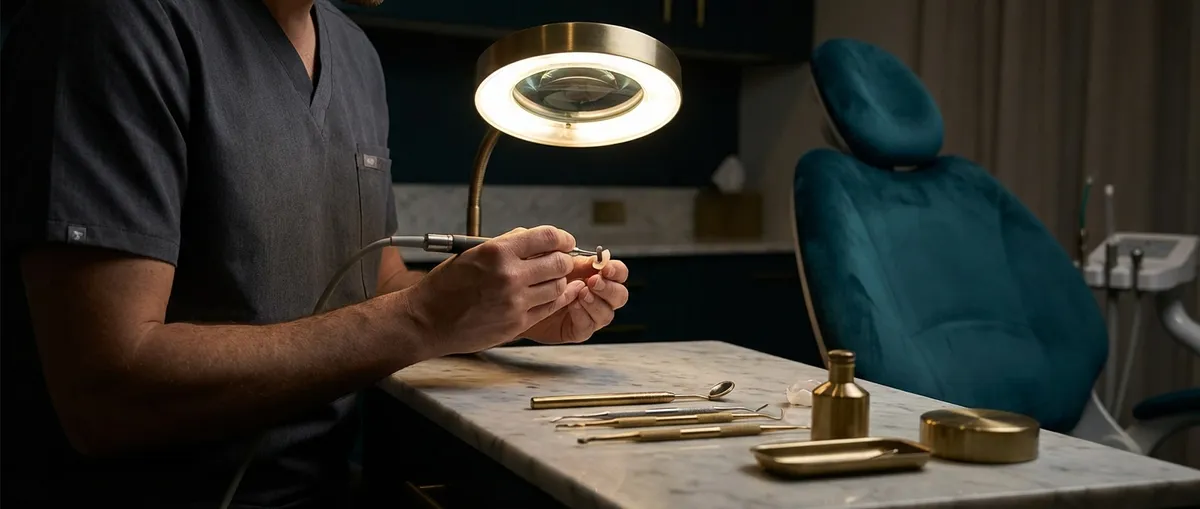
High-end porcelain systems are prized for their ability to mimic the way natural teeth interact with light. They are layered in micro-thin strata to recreate translucency at the edges, gentle opacity near the gumline, and subtle variations in hue that prevent the teeth from looking “flat” or artificial. Master ceramists may even incorporate tiny, almost imperceptible surface textures—delicate ridges, micro-luster, and faint characterizations—to ensure the restorations look like elevated nature rather than dental work.
Direct composite, when used by an expert, can also achieve remarkable results for bonding, contouring, or subtle refinements. Its advantage lies in its conservatism and adaptability: minimal or no tooth reduction, chairside customization, and the ability to fine-tune on the spot. In skilled hands, composite can be used as a “dress rehearsal” before porcelain, allowing you to experience a new length or shape before committing to a more permanent material.
Premium practitioners will not simply tell you that “porcelain is better.” Instead, they will discuss the language of your smile in terms of light reflection, durability, maintenance, and how different materials will age with you. The goal is to select a material palette that harmonizes with your unique complexion, lip tone, and personal style—high gloss, soft satin, or something exquisitely in between.
Five Exclusive Insights for the Serious Smile Makeover Client
For those accustomed to making considered, high-stakes decisions, a smile makeover is not a whimsical choice—it is a strategic one. These five underdiscussed insights can quietly redefine your experience and your outcome:
Preview is Power—Insist on Provisionalization
Before final porcelain is crafted, sophisticated practices will place high-quality “provisionals” (temporary restorations) that reflect your planned shape, length, and general design. These are not crude placeholders; they are a refined prototype. You live with them, speak with them, test them in different lighting, in photographs, and during important meetings. This preview period allows for nuanced refinements to tooth length, contour, and incisal edge position—long before the final work is bonded.
Your Smile Is a 3D Object, Not a Front-Facing Photo
Many patients focus on what they see straight-on in the mirror or on social media. A sophisticated practitioner designs for every angle: profile view, three-quarter turn, and how the smile interacts with your cheek volume and lip movement. This three-dimensional mindset avoids common pitfalls—teeth that look beautiful from the front but appear bulky or artificial in profile, or that create shadow gaps when you turn your head.
Micro-Symmetry Is More Elegant Than Perfection
Perfectly identical teeth can look surprisingly artificial. Natural, high-end results often contain deliberate, microscopic asymmetries: a slightly different angle of reflection on one lateral incisor, a subtle variation in edge translucency, or a very gentle difference in contour. These refined irregularities are almost imperceptible individually, but collectively they communicate “natural, elevated authenticity” instead of “obvious dental work.”
Time Is a Material—Rushing Is the Most Expensive Shortcut
Elite smile work is rarely a one-visit affair. Advanced whitening may be staged; orthodontic micro-movements may precede veneers; gum recontouring may require healing before final design. A well-orchestrated, multi-phase timeline allows tissues to stabilize and ensures that each subsequent step is built on a more predictable foundation. The investment of time is not an inconvenience; it is a critical ingredient in comfort, longevity, and subtlety of result.
Post-Makeover Stewardship Is Non-Negotiable
Once your signature smile is complete, maintenance becomes an integral part of protecting that investment. Sophisticated practices design a bespoke aftercare plan: customized night guards to protect against grinding, tailored hygiene intervals, professional polishing protocols that respect porcelain and composite surfaces, and periodic bite evaluations to catch micro-changes before they become visible problems. Patients who treat their smile like a curated asset, rather than a finished product, quietly enjoy their results longer—and with fewer surprises.
The Role of Subtle Orthodontics in a “Non-Orthodontic” Makeover
Many patients approach cosmetic dentistry hoping to avoid braces or aligners entirely. Yet in refined practices, discreet orthodontic intervention is often the key to achieving more conservative, more natural, and more stable results.
Clear aligner therapy or carefully planned limited orthodontics can gently reposition teeth to ideal locations, reducing the need for aggressive tooth reduction. Crowded teeth can be aligned so that veneers require only minimal reshaping. Protrusive teeth can be brought back into harmony with the lips, improving facial profile. Even minor rotations or vertical discrepancies can be harmonized orthodontically, allowing for thinner, more life-like porcelain.
The aesthetic advantage is significant: restorations that echo the natural contours of correctly positioned teeth tend to age more gracefully. They are less bulky, more translucent, and often require less intervention over time. In essence, orthodontics becomes a quiet collaborator, allowing cosmetic procedures to be lighter, more precise, and more respectful of your underlying tooth structure.
Choosing a Clinician: What to Look For Beyond the Portfolio
In a digitally polished world, photographic galleries can be seductive—or misleading. When evaluating a clinician for advanced dental procedures, look beyond the obvious before-and-after images.
Seek evidence of interdisciplinary thinking: Does the practice discuss collaboration with periodontists, orthodontists, oral surgeons, or master ceramists when appropriate? Are they able to articulate not just what they will change, but why each change is being made—and how it will support the health and function of your mouth?
Pay attention to how they speak about longevity. Do they address long-term wear, possible future revisions, and how restorations will integrate with your natural aging process? A refined practitioner plans not only for today, but for how your smile will look and feel years from now, under changing facial contours and lifestyle demands.
Finally, note how the consultation feels. In premium environments, the process is unhurried, inquisitive, and precise. You should leave not with a hard sell, but with a clearly articulated roadmap—diagnostics, phases, material options, potential limitations, and realistic expectations of what is truly achievable for your unique anatomy.
Conclusion
A high-end smile makeover is not an exercise in vanity; it is an intentional, technically complex collaboration between patient, clinician, and master technician. Behind the luminous surface of every elevated result lies a quiet orchestration of structure, material science, digital planning, and nuanced artistry.
For those willing to engage with the process at this level—embracing provisional phases, respecting timelines, and choosing a team that values both aesthetics and biology—the outcome is more than a set of beautiful teeth. It is a refined, enduring expression of identity that feels at once discreet, effortless, and unmistakably your own.
Sources
- American Academy of Cosmetic Dentistry (AACD) – About Cosmetic Dentistry – Overview of advanced cosmetic procedures, standards, and accreditation in aesthetic dentistry.
- Mayo Clinic – Dental Implants – Clinical explanation of implant planning, bone considerations, and long-term outcomes.
- Cleveland Clinic – Dental Veneers – Detailed discussion of veneer materials, preparation, and what patients should expect.
- National Institutes of Health (NIH) – Occlusion and Temporomandibular Disorders – Information on bite relationships, jaw function, and their impact on oral comfort.
- Harvard School of Dental Medicine – Digital Dentistry and Innovation – Insights into how digital imaging and design are reshaping modern dental procedures.
Key Takeaway
The most important thing to remember from this article is that this information can change how you think about Dental Procedures.