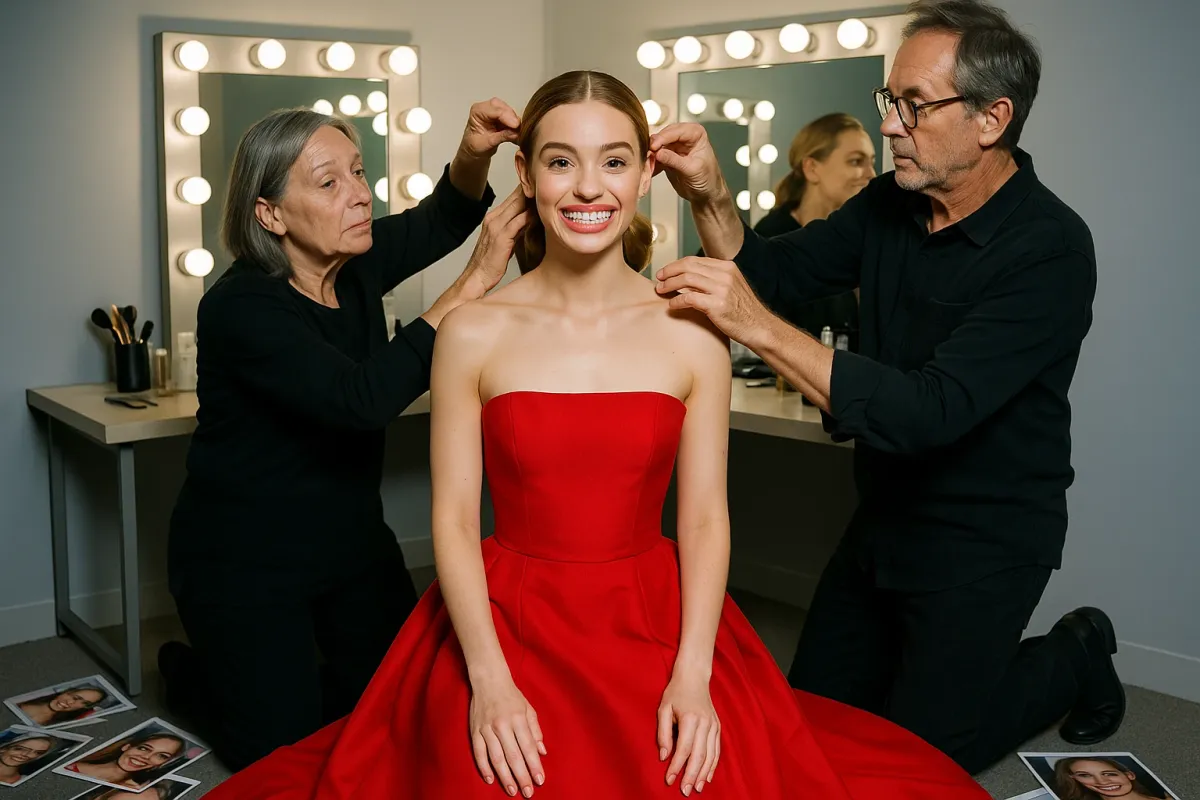
The internet has been abuzz over Millie Bobby Brown’s latest “sheer outfit” appearance on The Tonight Show Starring Jimmy Fallon, with fans claiming she has “skipped her 20s” and stepped abruptly into a hyper-adult image. While the headlines fixate on hemlines and sheer panels, there’s a quieter story under the spotlight: how fast-forwarded beauty expectations are reshaping what young women—and their dentists—are being asked to do.
As audiences scrutinize every detail of Millie’s evolving aesthetic, more patients arrive in dental practices with screenshots, filtered selfies, and “grown-up” celebrity close-ups, asking for instant sophistication. The result? A surge in demand for advanced smile procedures that don’t just whiten teeth but refine proportions, correct symmetry, and project a specific identity—youthful, yet unmistakably polished. If you’re considering a cosmetic dental makeover in this era of accelerated adulthood, the smartest move is not “more” but “more intentional.”
Below, five sophisticated, insider insights to help you navigate high-end dental procedures with the same level of curation you bring to your wardrobe and skincare—without losing yourself in the process.
1. “Adulting” Your Smile Is Less About Brightness, More About Proportion
In the wake of Millie’s debated “grown-up” look, many patients arrive wanting their smile to feel more “adult”—often translating that to ultra-white, ultra-straight teeth. Yet what actually reads as refined maturity on camera is not brightness alone, but proportion: how tooth length, width, and shape relate to your lips, gums, and facial structure.
Advanced cosmetic dentists now design smiles using facially driven planning software that maps the vertical thirds of your face, your lip dynamics in motion, and how much tooth shows at rest. An “adult” smile is typically characterized by slightly more defined incisal edges (the biting edges of front teeth), a controlled amount of central incisor dominance (front two teeth just subtly longer than their neighbors), and a shade that suggests health and refinement—not chalky artificiality. If your dentist immediately jumps to “Hollywood white” instead of discussing ratios and contours, you’re being styled, not designed.
2. Camera-Ready Doesn’t Mean Over-Processed—If You Choose the Right Procedures
As younger celebrities face red carpet scrutiny at ever higher definition, the industry has moved away from the thick, opaque veneers of early reality TV in favor of ultra-thin ceramics and minimally invasive bonding. Behind many of the most talked-about smiles today is a portfolio of subtle procedures layered together, not a single dramatic overhaul.
In top-tier practices, a camera-ready result might include precision enamel recontouring (microscopic reshaping of edges), localized bonding to soften a chipped corner, or a tiny adjustment to a lateral incisor that leans inward and catches shadow on camera. Professional whitening is often calibrated in stages rather than in one aggressive session, especially for those in front of studio lighting, where teeth can appear up to two shades brighter than in daylight. The lesson for you: a sophisticated makeover is rarely a blunt instrument; it’s a sequence of controlled refinements that keep your smile believable up close.
3. Your “On-Screen Age” and Your Dental Plan Should Match
One of the sharpest tensions in the Millie Brown conversation is age: audiences reacting not just to what she wore, but to what it signaled about the stage of life they believe she should be in. A similar dissonance happens in dentistry when a 22-year-old requests the same treatment plan as a 45-year-old executive—without considering long-term wear and maintenance.
Elite cosmetic dentists are increasingly talking about “age-appropriate treatment curves.” That may mean starting with reversible or low-commitment procedures (custom whitening, aligner therapy, micro-bonding) in your 20s, preserving untouched enamel for as long as possible. Comprehensive veneer cases, full-mouth rehabilitations, and more aggressive bite adjustments may be deferred—or strategically limited—so you’re not locked into heavy maintenance decades before you need to be. A refined practitioner will ask not only “What do you want to look like on Instagram next month?” but “What should your smile still be able to do, and look like, in 20 years?”
4. The New Luxury Is a Smile That Moves Beautifully, Not Just Poses Well
As Millie’s various late-night and red-carpet clips circulate, one constant is motion: laughter, side-profile angles, mid-sentence frames. The static press shot is no longer the only reference point—short-form video and candid stories are equally, if not more, influential. High-end dentistry has adapted accordingly.
Leading cosmetic dentists now evaluate your smile in motion: how your teeth flash during fast speech, how your lips track over the edges of your incisors, how your gumline appears in slow-motion laughter. Digital smile design often includes video capture, not just still photography, so the restorations are sculpted to look natural from every frame—not too flat head-on, not too bulky in three-quarter view, and seamless when you speak. For you, that means prioritizing providers who ask you to talk, smile, and laugh during evaluation, not simply “say cheese” at a single angle. A truly premium result is one that looks editorial in photos but utterly unforced in motion.
5. A Signature Smile Is the Ultimate Status Symbol—Not a Copy of a Celebrity
The discourse around Millie’s evolving style reveals a familiar pattern: the moment a public figure refines their image, thousands of quiet “I want that” screenshots land in stylists’, surgeons’, and dentists’ inboxes. Yet the most exclusive cosmetic work happening today is moving in the opposite direction—from imitation to signature.
Top-tier dental studios approach your smile less like a template and more like a bespoke commission. They consider your natural quirks—tiny asymmetries, a slightly softer canine, a trace of translucency at the edges—and decide which to preserve as your “signature.” Rather than erasing identity in pursuit of a generic celebrity look, they curate it. This is where advanced ceramics, hand-layered characterization, and custom shading come in: your restorations are crafted to echo the way your enamel naturally reflects light, your personal undertones, even your habitual lip color palette. The result isn’t “Millie’s smile” or anyone else’s—it’s a version of yours so refined that it couldn’t belong to anyone else.
Conclusion
As the internet debates whether Millie Bobby Brown appears “too adult,” the more meaningful conversation for anyone considering a dental makeover is about authorship and intention. In an era where public figures are scrutinized frame by frame, the most powerful choice you can make is not to chase a viral aesthetic, but to commission a smile that fits your face, your age, and your future.
Sophisticated dental procedures today are capable of remarkable transformation—but the true luxury is restraint, nuance, and individuality. When your dentist thinks like a designer, plans like a strategist, and treats your enamel like a limited-edition material, your smile becomes what it was always meant to be: not a costume, but a quietly commanding part of your identity.
Key Takeaway
The most important thing to remember from this article is that this information can change how you think about Dental Procedures.