The internet is having a field day with beauty disasters again. A Reddit group dedicated to bad makeup artists has just gone viral, with Bored Panda’s new feature on “40 of the worst” looks making the rounds across TikTok, Instagram, and X. It’s entertaining, yes—but beneath the shock-value eyeliner and foundation lines, there’s a deeper lesson for anyone considering a cosmetic dental procedure: when you chase transformation without expertise, the result is rarely luxurious.
In the same way a poorly blended contour can cheapen an otherwise beautiful face, an overdone or poorly planned smile makeover can instantly downgrade your entire look. As cosmetic makeup misfires trend online, discerning patients are quietly asking a more serious question offline: how do I make sure my smile transformation is timeless, not meme-worthy?
Below, we translate the zeitgeist of viral beauty fails into five refined, practical insights for anyone investing in a high-end dental makeover right now.
1. From “Instagram vs Reality” To “Consult vs Reality”: Why Overcorrection Kills Elegance
Those trending makeup fails all share one problem: too much. Too much foundation, too much highlight, too much contour. The intention—to sculpt and perfect—is sound; the execution turns theatrical instead of elevated. Cosmetic dentistry has its own equivalent: excessively white veneers, identical “template” smiles, and over-widened arches that look striking in photos but artificial in person.
A truly high-end smile makeover is not about maximum change; it’s about calibrated change. Your dentist should be curating your transformation with the restraint of a couture designer, not the enthusiasm of a filter app. Expect your clinician to talk you down from extremes: ultra-bright “toilet bowl” white, square edges on every tooth, or a uniform length that ignores your lip line and facial movement. If your consultation feels like ordering from a menu of smile presets, that’s a red flag. The most elegant results come from nuanced decisions rooted in facial proportions, not trends.
2. The Art of “Invisible Work”: Why The Best Cosmetic Dentistry Shouldn’t Announce Itself
In Bored Panda’s feature on the “Bad MakeUp Artists” subreddit, what makes the images so shareable is how obvious the work is—you can see exactly where it starts and stops. Harsh foundation lines at the jaw, unblended eyeshadow, false lashes lifting at the corner. You immediately know a heavy hand has been involved.
The same is true for dental work: obvious is rarely luxurious. Premium cosmetic dentistry aims for what insiders call “invisible work”—teeth that look like the very best version of your own, not like an entirely new set shipped overnight. This is where details matter: micro-translucency at the edges of veneers, non-uniform incisal edges, slight variation in color gradation from gumline to tip, and texture that mimics natural enamel rather than a flat, opaque surface.
When you consult with a cosmetic dentist, ask to see close-up photos and videos of patients speaking, laughing, and smiling—without ring-light perfection. You want to see how the work performs under unfiltered, everyday conditions. The more you can’t spot where the dentistry “begins,” the more confident you can be that your own result will age discreetly and beautifully.
3. Testing The Look Before The Commitment: The “Dress Rehearsal” Your Smile Deserves
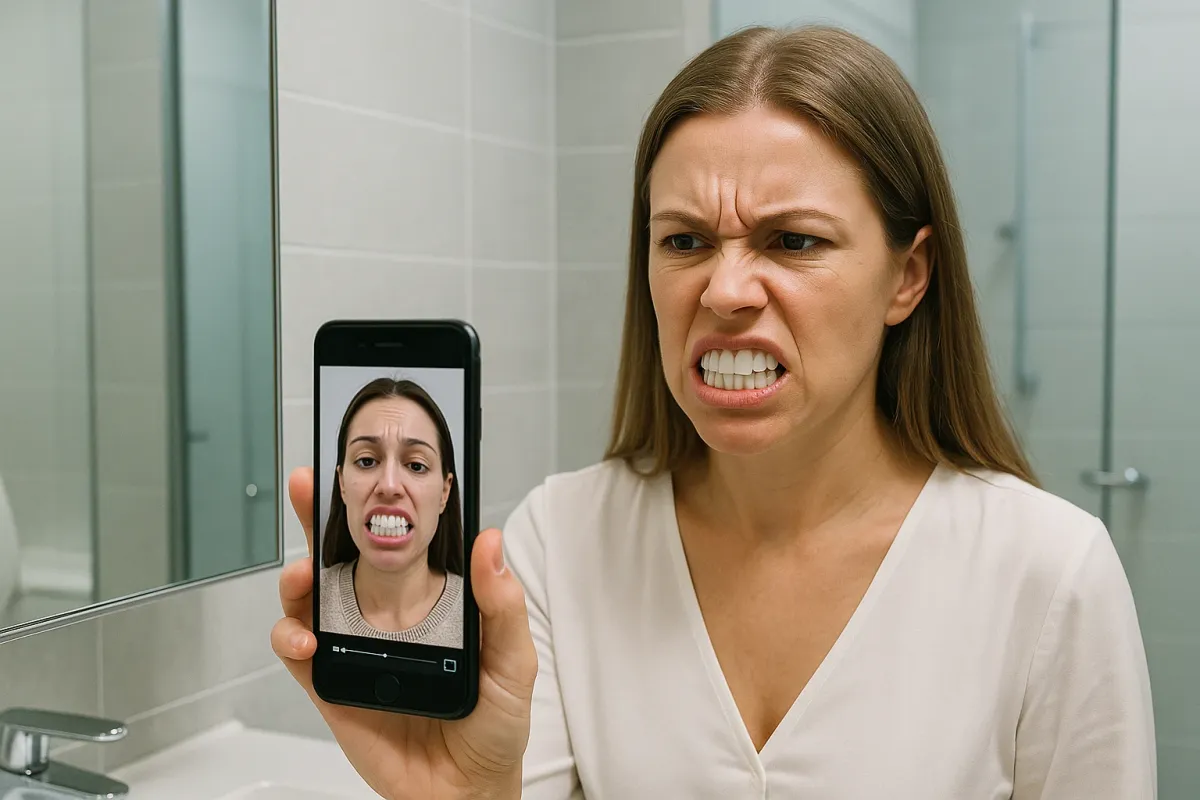
One recurring theme in the viral makeup fails: people walked out of an appointment, saw themselves in normal lighting, and were horrified. What seemed dramatic-but-fine in a studio mirror became shocking in daylight and on camera. The gap between expectation and reality is where regret lives.
In dentistry, that gap can be significantly reduced with a premium-level mock-up process. Sophisticated clinics are now offering:
- Digital smile design (DSD): high-resolution photos and scans are used to simulate your future smile on screen, taking into account facial proportions, lip dynamics, and even your typical expression.
- In-mouth mock-ups: temporary resin is placed directly over your teeth—without drilling—to let you “wear” a new smile for a few days. You can evaluate it in your own bathroom mirror, on Zoom calls, in candid photos.
If your dentist is ready to prep your teeth for veneers without first showing you a reversible mock-up—digitally or physically—you’re skipping a vital step. A luxury smile makeover should feel more like a bespoke fitting than a one-appointment surprise reveal. The modern standard is rehearsal before commitment.
4. Harmony Over Hype: Matching Your Smile To Your Personal Aesthetic, Not The Algorithm
The “Bad MakeUp Artists” subreddit is essentially a gallery of what happens when someone applies a generic, Instagram-inspired template to a face it doesn’t belong to: the wrong color palette, the wrong intensity, the wrong style for the occasion or personality. It’s not bad because it’s dramatic; it’s bad because it’s disconnected from the wearer.
Dental procedures can fall into the same trap. The hyper-uniform “influencer smile”—square, overly bright, and aggressively symmetrical—might look impressive in a single close-up shot, but it doesn’t necessarily suit every face, age, or lifestyle. True luxury in dentistry means your smile feels like part of you: aligned with your wardrobe, your grooming, your profession, and your natural expressiveness.
In your consultation, the conversation should go beyond shade charts and tooth lengths. Your dentist should be asking about:
- How formal or casual your daily life is
- Whether you lean classic, minimal, or fashion-forward in style
- How expressive you are when speaking and laughing
- What you love—and dislike—about your current smile
A refined smile makeover doesn’t chase what’s trending in 2025; it anticipates what will still feel like “you” in 2035.
5. Choosing a Dentist Like Choosing a Makeup Artist: Vetting For Taste, Not Just Skill
The viral makeup disasters aren’t always the product of amateurs; sometimes they’re done by professionals who simply have questionable taste, or who prioritize drama over refinement. The same nuance exists in dentistry: plenty of clinicians can technically place veneers or align teeth, but not all have an eye for understated beauty.
When you’re evaluating a dentist for a cosmetic makeover, look for the same signals you would in a top-tier makeup artist:
- A clearly defined aesthetic in their portfolio (is it soft and natural, or harsh and uniform?).
- Evidence of range—can they achieve subtle, nearly undetectable improvements, or is everything extreme?
- Reputation among discerning patients, not just volume of social media followers.
- Continuing education in cosmetic dentistry, facial aesthetics, and modern materials—not only basic restorative work.
Pay special attention to their “before and after” images. Do you see individuality preserved, or a series of nearly identical smiles? Are gums healthy and sculpted, or are they an afterthought? Are the results still attractive in casual, slightly imperfect photos, not just staged, retouched ones?
Taste is the invisible luxury in any cosmetic investment. In dentistry, as in makeup, it’s what separates a transformation from a spectacle.
Conclusion
As the internet laughs at over-lined lips and unblended foundation, there’s a subtle, timely reminder for anyone planning a smile makeover: the margins between aspirational and regrettable are razor-thin when aesthetics are handled carelessly.
A premium dental procedure today is about more than straight, white teeth. It’s about restraint instead of excess, invisible craftsmanship instead of obvious work, rehearsal instead of risk, personal harmony instead of algorithmic trends, and above all, a clinician whose taste you trust as much as their technical skill.
The beauty world may continue to serve us viral cautionary tales. Your smile doesn’t have to be one of them.
Key Takeaway
The most important thing to remember from this article is that this information can change how you think about Dental Procedures.