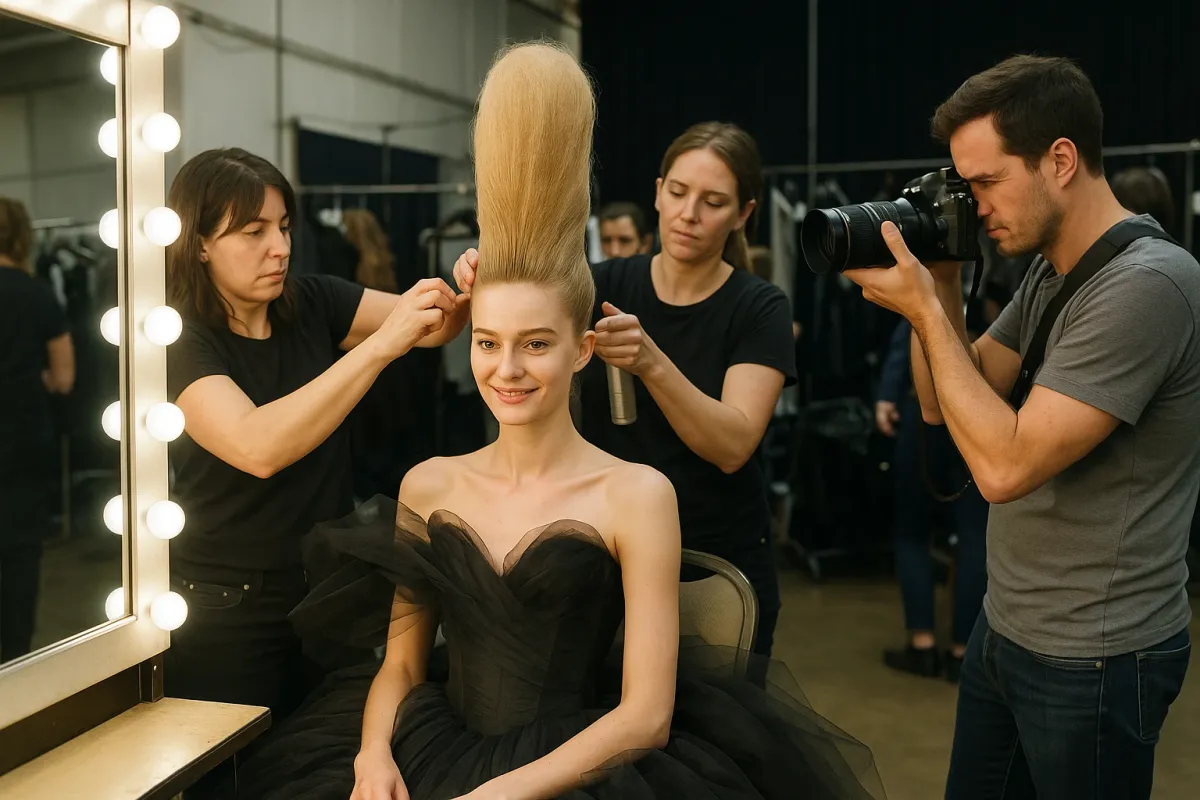
When Gwendoline Christie’s towering, tangled hair moment hijacked the British Fashion Awards coverage this week—earning the snarky label “a new home for lice” across social feeds—it proved something powerful about modern beauty: one dramatic feature can eclipse everything else. The gown, the makeup, even the bone structure become supporting actors when a single element dominates the frame.
For Smile Makeover Blog, that viral fashion moment is more than a meme; it’s a masterclass. Just as a gravity-defying hairstyle can overshadow couture, an unbalanced or neglected smile can quietly disrupt an otherwise flawless look. In an era when every close-up can be paused, zoomed, and shared, the smile is no longer a detail—it’s the anchor of your aesthetic.
As beauty headlines dissect Christie’s statement hair and viewers debate whether it’s art, excess, or simply impractical, discerning patients are asking a smarter question: how do you ensure your smile is the feature that reads as intentional, elevated, and impeccably finished in every shot?
Below are five exclusive, timely insights for anyone planning a high-end dental makeover in a world where beauty moments trend—and are judged—in real time.
1. The New Red-Carpet Rule: Your Smile Must Survive Every Angle
The Fashion Awards uproar around Christie’s hair wasn’t about whether it looked compelling from one camera position; it was about its impact from every angle, under harsh lenses and unforgiving lighting. Your smile is held to the same standard now. Between 4K video, event photography, and social media reposts, a luxury smile must be architected, not improvised.
Modern cosmetic dentistry is increasingly guided by “camera-first” design. Dentists are using digital smile simulations, 3D scans, and even video test shots to anticipate how your teeth read in motion, not just in a static mirror glance. Incisor length is calibrated so that in a laugh, they frame the lip rather than vanish; lateral incisors are contoured so they don’t create odd shadows in profile; translucency is adjusted so that flash photography doesn’t wash them out into a flat slab of white.
If you’re consulting for veneers or a full-mouth reconstruction, insist on evaluating mock-ups under different lighting conditions—daylight, soft indoor, and direct flash—just as a stylist would test how a gown photographs on the step-and-repeat. A premium result isn’t simply “straight and white”; it’s a smile that remains coherent and elegant whether you’re seated at dinner or caught off-guard by a paparazzi-style smartphone snap.
2. Texture Is the New Status Symbol in Cosmetic Dentistry
The internet’s “lice” jokes about Christie’s elaborate hairdo touched on something people rarely name but instinctively notice: texture. Hair that’s too slick can look like plastic; hair that’s too chaotic can read as unkempt. Teeth are no different. The most obviously “done” smiles today are not always too white—they’re too flat.
Top-tier cosmetic dentists are moving away from glassy, uniform veneers and toward micro-textured surfaces that mimic natural enamel. Under soft light, this subtle texture catches and diffuses highlights, creating a gentle radiance rather than a blinding sheen. Under flash, that texture prevents the “fake tooth” reflectivity that instantly dates an otherwise expensive smile.
When you review veneer or crown options, look closely at surface detail. Do the teeth have faint vertical striations, gentle scalloping at the edges, and nuanced transitions of sheen? Or do they resemble opaque tiles? Ask your dentist about:
- Layered ceramics rather than single-shade blocks
- Hand-finished surface characterization
- Translucent incisal edges that diffuse, not mirror, light
In the same way a couture gown is defined by the hand of the fabric, a luxury smile is defined by the sophistication of its texture. It should whisper craftsmanship, not shout “fresh from the lab.”
3. Harmony with Hair, Lips, and Skin Tone Is Now Non‑Negotiable
Christie’s headline-grabbing hairstyle worked (or didn’t, depending on your taste) because it was in direct tension with the rest of her look. That tension may be intentional on the runway, but for a real-life makeover, you want harmony—not competition—between your features.
Teeth never exist in isolation; they interact with hair color, lip tone, and complexion. As beauty trends swing between extreme hair statements (from bleached brows to inky bobs to sculptural updos) and minimalist makeup, the smile must act as a stabilizing axis. A harsh, blue-white shade can clash with warm blondes and golden skin, while overly muted tones can disappear against deep, cool complexions.
For a genuinely bespoke result:
- Bring reference photos not only of smiles you love, but of your usual hair color, makeup, and wardrobe palette.
- Consider whether you frequently experiment with dramatic hair changes. If so, ask for a tooth shade with a neutral base that coexists gracefully with both cool and warm aesthetics.
- Discuss lip volume—natural or augmented. Fuller lips can visually shorten the teeth; a very thin lip line can expose more enamel. Proportions should be set after you commit to (or at least anticipate) your preferred lip shape.
The elite standard isn’t “perfect teeth” in a vacuum; it’s a smile that feels so integrated into your look that even dramatic hair and makeup can come and go without unsettling the balance.
4. Maintenance Is the New Luxury—Not Just the Makeover
The internet was quick to question the practicality of Christie’s elaborate hairstyle: how do you live with it beyond the carpet? The same question applies, quietly but insistently, to ambitious dental work. Veneers and full-mouth restorations are not a one-night-only look; they are a daily commitment.
Premium patients are rethinking the value of aftercare as part of the investment. That means:
- Scheduling regular polishing with ultra-fine pastes that preserve ceramic texture and gloss rather than eroding it.
- Wearing custom night guards if you clench or grind—many of the most catastrophic veneer fractures stem from ignoring this single piece of advice.
- Planning professional whitening for natural teeth adjacent to restorations so the overall shade harmony doesn’t drift as you age.
Today’s beauty conversations—whether about towering hair or contour-heavy makeup—circle around one central question: “What does this look like tomorrow?” With a high-end smile, the answer should be “precisely as intentional, refined, and polished as it did on day one.” Longevity is the real flex.
5. Subtle Is Photogenic: Why The Finest Smiles Don’t Trend as Memes
Christie’s hair stole headlines because it didn’t try to disappear; it demanded attention. Your smile, on the other hand, should command admiration without ever becoming the joke or the meme. The most luxurious cosmetic work rarely goes viral because it doesn’t invite commentary—it feels inevitable, as if it has always belonged to your face.
This is where restraint becomes the ultimate mark of sophistication:
- Slightly varied tooth lengths keep the smile from looking like a single, unbroken line.
- Tiny asymmetries—a marginally softer corner here, a hint of rotation there—mimic the irregularities that make real, youthful smiles so compelling onscreen.
- A half-shade below “maximum white” often reads cleaner and more believable in photographs, especially in close-ups.
Ask your dentist how they plan to avoid the “template smile” look. Do they design around your facial midline, lip mobility, and natural expressiveness? Do they show you side‑profile simulations, not just frontal ones? The goal is a result that looks exquisite in candid laughter, not only in the static “after” photo.
In a culture that screenshots everything, the true test of a smile is this: when your image circulates, are people talking about your teeth—or simply about how effortlessly striking you look?
Conclusion
As fashion watchers debate Gwendoline Christie’s avant‑garde hair and Twitter wavers between admiration and ridicule, one principle emerges clearly: in 2025, beauty is judged in high definition, at high speed, by a global audience. One exaggerated feature can overshadow months of meticulous preparation.
A considered smile makeover answers that reality with quiet authority. It is engineered for every angle, textured for natural luminosity, harmonized with your overall aesthetic, protected by disciplined maintenance, and refined with enough subtlety to evade the meme machine entirely.
When the cameras find you—on a red carpet, at a wedding, or in a simple tagged photo—you deserve a smile that doesn’t beg for attention, but effortlessly earns it.
Key Takeaway
The most important thing to remember from this article is that this information can change how you think about Oral Health.