Celebrity beauty is having a maximalist moment. Fresh ink, stacked piercings, and bold transformations are dominating our feeds—and this week, Cardi B’s new constellation of neck and back piercings has become the latest flashpoint. While the online conversation has focused on whether her new body art is “too much” so soon after welcoming her child with Stefon Diggs, there’s a quieter, more consequential question luxe beauty seekers should be asking: how do extreme aesthetic trends intersect with oral health and high-end smile design?
For patients planning a sophisticated smile makeover—veneers, aligners, implants, or full-mouth rehabilitation—the Cardi B piercing discourse is more than gossip. It’s a real-time reminder that every beauty decision you make above the shoulders (and sometimes beyond) can influence healing, infection risk, and the long-term stability of your dental work. Below, we explore five exclusive, often-overlooked insights that discerning patients should consider before pairing a premium smile with headline-making body modifications.
The Hidden Infection Chain: Why “Distant” Piercings Can Threaten Your Smile
It’s easy to assume that neck and back piercings, like Cardi B’s, are far enough from the mouth to be irrelevant to oral health. In reality, your circulatory and immune systems don’t respect aesthetic boundaries. Any piercing—especially the kind that involves multiple sites and extensive hardware—creates new portals for bacteria to enter the bloodstream.
For patients with recent implants, gum surgery, or full-arch reconstructions, systemic infection is the silent saboteur. Bacterial load from an infected piercing can contribute to peri-implantitis (inflammation and bone loss around implants), delayed soft-tissue healing after grafts, or even failure of complex restorative work. Elite cosmetic dentists quietly factor in your overall inflammatory burden; if you’re healing from multiple piercings or tattoos, they may recommend delaying elective dental surgery until your skin is fully stable. The takeaway is not “never get pierced,” but rather to sequence your beauty investments thoughtfully, recognizing that spotless aftercare for body art is part of protecting a six-figure smile.
The “Healing Bandwidth” Principle: Don’t Overload Your Body Before a Makeover
Cardi B’s rapid return to invasive beauty procedures postpartum sparked criticism about whether her body had enough time to recover. Stripped of the tabloid noise, this raises an important principle for anyone considering a major smile transformation: your body has finite healing bandwidth.
If you’re stacking treatments—jawline filler, rhinoplasty, neck piercings, and veneer prep, for example—you’re asking your immune system to manage multiple micro-injuries simultaneously. This can manifest as prolonged gum tenderness after crown lengthening, increased swelling after extractions, or unpredictable responses to whitening or bonding materials. In luxury dentistry, timing is an art form. A refined treatment roadmap staggers skin work, injectables, and piercings around dental milestones: bone grafts and implant placement receive prime healing windows; high-friction or immunologically demanding procedures (like fresh body art) are scheduled well before or after. If you want red-carpet results, plan your year, not just your appointment.
Jewelry, Metal, and Your Bite: How Aesthetic Hardware Interferes with Precision Dentistry
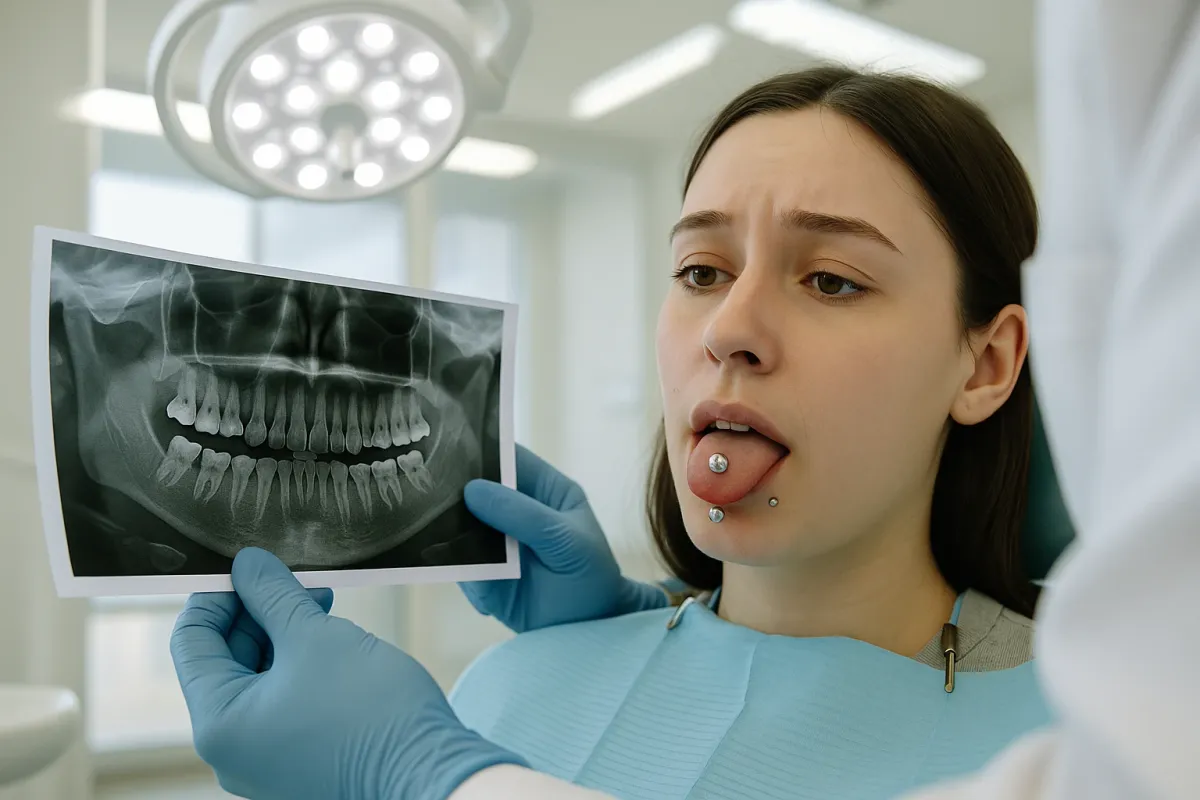
While Cardi B’s latest piercings are away from the mouth, many fans are simultaneously experimenting with oral jewelry—tongue studs, lip rings, and even “grillz”—as part of the same aesthetic wave. For cosmetic dentists working at a premium level of precision, this hardware is more than a style choice; it’s a biomechanical and material challenge.
Tongue and lip piercings can chip porcelain veneers, fracture ceramic crowns, and wear down natural enamel in a way that undermines the symmetry and polish of your makeover. Even non-oral piercings can complicate imaging: metal in facial or neck areas can create artifacts on certain scans, obscuring fine details needed for implant planning or orthognathic assessment. A high-end practice will ask you to remove as much jewelry as possible for scanning and often provide tailored guidance on what types of oral accessories are least likely to compromise your results. The sophisticated approach is not purely “no piercings ever,” but rather: choose placements, materials, and dimensions that respect the geometry and fragility of your new smile.
Postpartum and Beyond: Hormones, Gums, and the Perfectly Timed Smile Makeover
Much of the Cardi B controversy centers on post-baby timing—how soon is too soon for invasive beauty? Dentistry has its own, less visible version of this conversation. Hormonal shifts during pregnancy and postpartum can dramatically affect the gums, resulting in increased bleeding, puffiness, and altered inflammatory responses. For someone eyeing a veneer case, implant bridge, or comprehensive orthodontic movement, these subtle changes can be the difference between “flawless” and “finicky.”
Premium clinicians know that the most photogenic results rest on impeccably healthy, stable soft tissue. If you’re in a postpartum window or navigating other major hormonal inflection points (perimenopause, fertility treatment, gender-affirming hormone therapy), your dentist may recommend a phased approach: short-term cosmetic refinements and hygiene intensification now, with more permanent structural changes scheduled once your biology has settled. In this context, dramatic new piercings or body modifications—each demanding healing resources and sometimes provoking inflammatory flares—may be better spaced out from your dental milestones. True luxury is not speed; it’s strategy.
Designing a Cohesive Aesthetic Story: Smile, Skin, and Statement Piercings
Underneath the commentary about whether Cardi B’s new piercings are “too much,” there’s a deeper aesthetic question: how should multiple beauty choices coexist without feeling chaotic or cheapening one another? For clients investing in top-tier smile design, this is where the conversation becomes exciting rather than restrictive.
A beautifully executed smile makeover is not a standalone feature; it’s an anchor. The shade, shape, and proportion of your teeth frame your lip color, harmonize with your skin tone, and even influence how bold piercings or jewelry read on camera. A cooler, ultra-white veneer palette may compete with heavy metallic hardware; a softer, slightly translucent shade paired with meticulous pink aesthetics (the gums) can elevate even avant-garde body art, making it look editorial rather than impulsive. Sophisticated practices increasingly collaborate with dermatologists, facial plastic surgeons, and even stylists to ensure that your smile, piercings, and skincare form a coherent visual narrative. The result is not simply “perfect teeth,” but an integrated, modern identity that photographs beautifully from every angle.
Conclusion
The discourse swirling around Cardi B’s new neck and back piercings may look, at first glance, like just another celebrity flashpoint. For those pursuing high-end dental transformations, however, it’s a timely reminder: every beauty decision—every piercing, injection, or procedure—lives in the same biological and aesthetic ecosystem as your smile.
Protecting and elevating a premium smile means thinking beyond the dental chair. It requires immaculate infection control for body art, respect for your body’s healing bandwidth, thoughtful hardware choices, nuanced awareness of hormonal timing, and a commitment to a cohesive visual story. In a world where transformations trend overnight, the most luxurious choice you can make is a strategy that lets your smile—and every detail around it—age gracefully, powerfully, and entirely on your own terms.
Key Takeaway
The most important thing to remember from this article is that this information can change how you think about Oral Health.